
So You Want To Lead...Better Know Sales!
I was not sure why I needed to know sales at the time to be a good manager, but I knew I would figure out why someday.
When I first started in sales it was on the premise that if I wanted to be a great manager, business owner, lawyer, president, I needed to know sales. That is what a successful business owner told me after I had told him that I wanted to be a manager in the next five years. He was a great leader and still has people working for him that were with him since he opened his company in the mid 1980’s. I was not sure why I needed to know sales at the time to be a good manager, but I knew I would figure out why someday.
At first, I was hesitant to change careers. Six months of hesitation and discussions to be exact. I did not want to be a salesperson because all life had taught me was that they were only out for their own gain. I did not want to actively be associated with that stigma?
When I did decide to try this sales thing out, I figured that sales would be easy. The first year of sales was a rude awakening. It literally looked like a heartbeat of someone that just took their last breath. I was fortunate to have a chance to keep going and learning from the successful business owner in what he called “hands on training.”
Hands on training meant that I was to help him with projects after hours, gain training from peers, and hours of trainings to perfect my craft. I did weekend deliveries, helped him with personal projects, etc. Basically, anything he needed extra help with I was there. This was valuable time with him mentoring me all he knew about sales and business.
I excelled from then on to become a great sales leader in my industry and even relocated to another part of the United States to help grow a new territory. We did very well there with great purpose. Customers started opening up fast to me and sales were increasing as the years went by. I was awarded the prize of top salesman for the United States and had taken the territory to where it had never been. I won’t give all those secrets away today on how we did this, but I can tell you it was not because we were the cheapest price or by doing anything unethical.
What I can tell you is that this success was because of Influence. As influence increases people trust us more and are willing to go deeper in relationships with us. These relationships open up the doors to long lasting and deep relationships. The more influence someone has the more they excel in whatever they are doing.
I had customers asking me about other aspects about their business as time went on. They were confiding in me as a trusted asset that could help them break through their ceiling to the next level. It was eye opening that I was able to help them with simple things up to the complex integrations of business solutions.
What I found is that the sales process that I keynote and perform trainings on helps people build amazing amounts of influence fast! That is right, selling correctly helps us build influence! Keep in mind that selling is not just a product or service. It can be selling a vision, mission, or idea that we need others to help us achieve. By building influence using the sales process, leaders gain more engagement their teams.
As you look around your organization look at those relationships of those that go out of their way to help you and those that don’t. See how much influence you have with each of these groupings of people. The more influence you have, the farther you and your organization will go.
Happy selling!
Sincerely,
Kevin Sidebottom
“Businesses wonder why the majority of their sales teams struggle at winning profitable business. I teach your sales team to walk with the customer through the five buying decisions, and in the correct order to generate more sales with high margins!”

Do You Trust Me…?
We have to have trust in relationships, the products we use in our daily lives, our organizations we work for, basically we have to put some trust in everything we come in contact with.
Have you ever noticed in just about every action movie there is this one moment where the two last survivors are about to make some kind of daring jump to freedom with the phrase just prior, “Do you trust me?” Just once I would like to see one of them say, “nope I’ll take my chances…” and see how the director makes it work.
Movies play out this request all the time, but in actuality we are asking this question to just about everyone we come in contact with.
Trust is a huge mechanism for us to function with others. We need to trust that they will not hurt us, steal from us, or do anything to affect us negatively in our daily lives. Trust is a big deal! It is part of our survival mechanism, so we need to think about that when we are working with others especially in business.
I have studied the art of building rapport with people for over a decade and trying to understand how to build deep relationships with customers. One of the key ingredients to building rapport with people is trust. If we don’t have trust, we will not be able to function effectively in the sales process. Trust is crucial!
We have to have trust in relationships, the products we use in our daily lives, our organizations we work for, basically we have to put some trust in everything we come in contact with. We trust that the vehicle we drive will not just explode when we turn the key or push the start button. We trust that the engineers and the manufacturing individuals have assembled the product / service so that it will function properly.
I have had to work at being trustworthy and to show my trustworthiness to those I have come in contact with in all situations. Early in my sales career, I took over sales territory in Florida which our organization had never had distribution in. We had to work extremely hard to build trust with this new customer base.
I took a Dale Carnegie course on human relations, learned all I could about the new products as well as the competitive landscape, and did a great deal of leg work to build the trust that we were going to do what we said we were going to do for our new customers. This meant a great deal of studying the competitive landscape while on the road, going out to sell products for my customers to their customers, train my customer’s sales force, help them with marketing, etc. There was a great deal of effort on my part to build trust.
Amazing things happened as a result. Some of my customers asking my opinion on other aspects of their business, products they were looking to purchase, inviting me on fishing / hunting trips to their properties, etc. Our Sales were taking off as well! I have even received phone calls from past customers to catch up even though I have not called on them in over eight years. I am excited when I see my customers winning!
Trust is a huge factor in organizational success, teams, and relationships. Without trust we won’t get very far in life. We need to put forth great amounts of focus on building trust with those we come in contact each and every day. I do this when I am speaking with organizations on how to help them, writing blogs, and recording videos to help each and every one of you get some insight in hopes that you have more success. Trust is a huge moral obligation to me.
I have had the opportunity to speak on trust to organizations that builds axles, drive shafts, robotic solutions, sell real estate, and financial services. The one common theme that all took away is that if they wanted to move forward faster, they needed to have high levels of trust in their organizations. The world moves fast and with trust we will be able to keep up!
If you would like access to an online training at a fraction of the cost of having me come in to speak to you and your team check out my Trustworthy training that you can take where ever you have an internet connection and at your own pace.
Sincerely,
Kevin Sidebottom
“Businesses wonder why the majority of their sales teams struggle at winning profitable business. I teach your sales team to walk with the customer through the five buying decisions, and in the correct order to generate more sales with high margins!”

Having a Plan to Succeed in Sales
Is doing business with your organization that beneficial for the customer? If not, your product / service will be considered just another commodity with the only differentiator being price.
A few years back a friend and myself decided it would be a great idea to do a sprint triathlon. I figured I was in decent shape and could swim well. After all, once you finished the swim all you had to do was hop on a bike for a bit and then run a 5k. I have done 5k runs many times so I was not worried about the run and I bought a road bike so I could ride faster than a mountain bike. I did two swims in the water, road the bike a few times, and I didn’t need to run because, hey I could do it. I figured I had it all planned out to succeed and do well… figured I had it planned out enough…
The day came for the race and my friend and I were in the water ready to go. The starter sounded of the start of the race and we both jumped in with our awesome swim caps. About ten strokes into the swim I was out of energy. I looked up and saw that there were only two rescue boats and a long way to go. At that moment I knew I was in for a long day. I did every stroke I could and did the dead man’s float sometimes. Eventually I made it through the swim, did the bike, and then got into the run. I was so not prepared for that event.
The next year I trained and planned, and then trained some more. The results were very different because of a better training plan and executing that plan.
In sales, if we want to do well, we need to have a plan and work the plan. We can’t just show up and expect to for sales to just happen. We need to map out where we want the conversations to go and what areas will hit the customer’s needs. We need to review our notes about the customer and figure out what solutions we can address for them to help them. One image that still is in the back of my mind when I am visiting with customers and training is that of handing a bill to the customer when I am leaving.
Was the time spent with me worth the customer paying me?
Would your customer say the time spent with you worth $200, $250, or even $500 for that hour meeting?
What kind of solutions did the customer come away with that will equip them to function more profitably?
Is doing business with your organization that beneficial for the customer? If not, your product / service will be considered just another commodity with the only differentiator being price.
A plan is needed to make the sales call worth both parties investment of time and resources. This is a new age and because of technology customers are more informed and need sales professionals to help them create their unique solution.
What does your sales call plan look like?
What are your premeeting preparations?
Are you answering the three questions your customer is asking at each interaction?
Do I like you?
Do I trust you?
How can you help me?
Create the plan, execute the plan, and have a back-up plan if something happens that you didn’t expect. Be prepared. And if you do a triathlon, practice swimming, it could be the difference between life and death out there!
Sincerely,
Kevin Sidebottom
“Businesses wonder why the majority of their sales teams struggle at winning profitable business. I teach your sales team to walk with the customer through the five buying decisions, and in the correct order to generate more sales with high margins!”

The Cold Call...
A cold call will take most people out of their comfort zone.
How many of you fear picking up the phone and calling a prospect that you have never talked to before?
How many of you visualize the person on the other end of the phone screaming to stop calling?
A cold call will take most people out of their comfort zone. It’s scary, we don’t want people hating us while we call at dinner time. They also will likely not believe us when we say our name is Tom, John, Sam when we have an accent from another country (with more interesting names). Many organizations these days have gone to the robo call which is really annoying.
I especially like when they start the message with “Don’t hang up…” They are literally telling me to hang up on them subconsciously by saying that opening line. A better opening would be “ Keep listening for some great information…” That would create more tension in me to want to hear more.
Cold calling is almost an art form. To get the person on the line and talk to us takes practice. I still to this day do cold calls to associations and businesses to drive more business. Prospecting is key in growing our business. Cold calling is not just dialing a phone either. We can walk into a business that we have reviewed and think would benefit from our expertise. Just watch for those no trespassing signs.
Cold calling is not natural for me as I am more of an introvert by nature. Pushing myself out of my comfort zone is a must if I want to grow my business. I have gotten voicemails and had to leave a message, people asking me to call them back later, people using a firm tone that they are not interested, and sometimes, sometimes I get great conversations with them and an appointment to visit to discuss more.
That is what the cold call really is. The opportunity for the further conversation. We are likely not going to make a sale on this call. Our focus should be to get that opportunity to come in and sit with the person to learn about them and their organization. How we can help them get to a better place. Our product possibly will enable them to take that next step in their growth. That is a good reason to talk to prospects? We need the opportunity to start the conversation.
Insurance sales professionals have lists of people they cold call every day. They have studied statics over the years and have a metric that out of ten calls three should result in “Fact Finding Opportunities” and then should result in one quotation of their product. That is a 10% success rate for sales. Very few professions have studied the results. I have met quite a few wealthy insurance sales professionals and they all have told me that they do this by making cold calls. If we are going to be successful selling, we need to do cold calls and prospect.
Keep in mind though that the person on the other line has three questions that they are asking themselves when we start talking.
1. Do I like this person?
2. Do I trust this person?
3. How can this person help me?
If you’ve read my book, “That Sales Process Uncovered”, been to a training, or been a reader of my blog for a while you should be able to answer these questions for them. Social media such as linked In, Facebook, Instagram, Twitter, etc have made it even easier to research our prospects prior to the cold call. We just need to do the research.
For now, don’t fear the cold call. Accept it as an opportunity to help potential customers get to a better place. Who knows, you may strike up a great conversation and learn something new about someone that will help you at a later date. This is your opportunity to start helping people. Now pick up the phone and see how.
Have a great weekend!
Sincerely,
Kevin Sidebottom
“Businesses wonder why the majority of their sales teams struggle at winning profitable business. I teach your sales team to walk with the customer through the five buying decisions, and in the correct order to generate more sales with high margins!”

Did You Know You Are In Customer Service?
People tend to tell everyone they know about how great an experience was as well as how awful an organization is to deal with.
I have had great customer service experiences at organizations and not so great experiences from other organizations. These experiences have ranged from great purchasing experiences to awful hold times with the worst elevator music ever composed. I have had IT people who walked me through the complete inner workings of their phones and helped me with my purchase, and I have been treated as if I was a burden on the representative that had to take another call during their shift.
People tend to tell everyone they know about how great an experience was as well as how awful an organization is to deal with. There is a lot riding on customer service and if our organizations are not careful, we will lose out on a great deal of opportunities in the future. Here’s the thing though…everyone in the organization is actually working in customer service. That’s right it does not matter the position. When we interact with customers, we are essentially working in customer service.
It does not matter if we are the CEO, a sales person, an engineer, a call center employee, or a janitor. We are ambassadors for the organizations we represent. We have the opportunity to build up or tear down the reputation of our organization by how we treat others. We need to keep that in mind when we are sporting our organization’s name, at events, and even what we post on social media.
It also does not matter if we are not a paid, or not. When people see us representing an organization, they are making the association no matter our affiliation. People will make their perceptions about the organization based on the people they interact with.
I have had people in organizations tell me they don’t care if a customer likes it or not because they don’t have to interact with the customer regularly. It’s frankly, not their job. Unfortunately, what these individuals don’t understand is that the customer is buying products / services that are in turn funding their paycheck. Make enough customers stop buying from our organization and then we are all looking for other employment.
When the customer has a bad experience, social media allows them to send their experience all over the world in a matter of seconds. Organizations do not have the ability to respond to every negative comment on all of the social media platforms. There is just too much area to cover, but we can make sure we do our part and give the customer a great experience each and every time we interact with them.
No one is above customer service. We are all serving customers. Whether we like it or not, our organizations are judged by our actions. Keep that in mind when you are wearing your organization’s logo, or at an event for your organization. Make the interaction a positive one. Be courteous, helpful, gracious, and humble. Go the extra mile to help someone even if they are not buying from you right then and there. Your organization’s reputation and your paycheck actually do depend on it.
Sincerely,
Kevin Sidebottom
“Businesses wonder why the majority of their sales teams struggle at winning profitable business. I teach your sales team to walk with the customer through the five buying decisions, and in the correct order to generate more sales with high margins!”

Why Emails Aren’t Necessarily Better
How many times have you said, “I’ll just send a quick email” and it took twenty back and forth emails to where you finally picked up the phone to clear something up?
Have you ever gotten really upset with someone over email only to find out that they did not mean any harm when they sent it?
How about this one? Have you ever been overwhelmed because you had so many emails to respond to?
How many times have you said, “I’ll just send a quick email” and it took twenty back and forth emails to where you finally picked up the phone to clear something up?
Have you ever gotten really upset with someone over email only to find out that they did not mean any harm when they sent it?
How about this one? Have you ever been overwhelmed because you had so many emails to respond to?
I am guilty of all three of these more times than I care to admit. Over 124 billion emails are sent each day all over the world in hopes of resolving questions fast. Email was created to make communication easier and efficient. The issue is most people think that email is the save all be all when it comes to communicating to others. They hide behind computer screens sending off their requests and responses in hopes that the issue will go away quickly, only to have the email come boomeranging back with more questions or requests for information. Then we send responses and more questions of our own to the other person to which they respond, and the conversation keeps going on and on very slowly.
A few things to remember on emails are that in great communication the majority of communication is non-verbal (or written word), people tend to take written word in a negative point of view, and the person reading the words does not always know the context. This makes it ever harder for you to communicate effectively through email. Text messaging is also one of these communication mediums that get people into trouble. People tend to use it also as a means to cya (look it up) in case something bad happens.
Emails can be used also in harassment cases. I have seen people twist words from emails into the ability to sue an organization for harassment. Keep that in mind when you are upset and wanting to respond to someone to make yourself feel better. The same can be said for text messages.
Back to the main topic with emails… Most questions are easily answered, but I bet the number of emails would greatly decrease if people used a phone call instead. I have found that reaching out to others via conference calls, quick phone calls, or video meetings obtain faster results in less time than the flurry of emails that depending on workloads take days or weeks to have the responses come back to close the discussion.
New software platforms such as Loom, Zoom, Teams, Meets are being presented into the marketplace for people to speed communication up greatly. Most smart phones have the ability to video call now as well. Let’s also not forget about walking up to the people we need to communicate in person if we are in the same office.
People crave community and relationships so being present is a best way to communicate in my opinion. The problem is that we as a society have focused so much on becoming efficient in communication that we tend to miss the mark when trying to communicate. Communicating with others is vital to get our goals accomplished. It is very rare for someone to complete a great task all on their own. They need others to help them move forward.
I have taken great pride in increasing my communication by helping others understand clearly what I am trying to accomplish. Most of the time I try to do that with conversation rather than email. Please be intentional when working through emails to be as clear as possible in communicating if you chose not to talk to the person and help them understand the complete setting.
If you must write an email below is a process I work through when sending out emails:
1. Write the email as though the person receiving the email has no idea what you are talking about and the scope of the situation. ( But keeps short of a thesis paper)
2. Focus on your audience and especially if they are in another country to not write your email in your slang as they may not understand it.
3. Read the email through prior to sending to make sure the topics are clear and concise.
Sincerely,
Kevin Sidebottom
“Businesses wonder why the majority of their sales teams struggle at winning profitable business. I teach your sales team to walk with the customer through the five buying decisions, and in the correct order to generate more sales with high margins!”

Do You Know The Most Important Variable In Trust?
We have seen politicians, CEO’s, and sales professionals all brag about how they did something great and how they deserve all the credit. Unfortunately, anything worth doing takes a great deal of effort and typically takes support of others.
Now that the elections are hopefully over and trust is very much a commodity that is lacking today, I figured I’d talk about one of the biggest factors in building trust. We need trust in others if we are going to go anywhere. Without trust not much is possible. Today let’s talk about one of the most important variables in building trust.
That variable is Selfishness. We have seen politicians, CEO’s, and sales professionals all brag about how they did something great and how they deserve all the credit. Unfortunately, anything worth doing takes a great deal of effort and typically takes support of others. We need to make sure we are not killing trust with self-promotion.
When I created the trust equation it was to make it easy for people to see the basics of building trust. You can be very creditable, reliable, and vulnerable, but if we are only doing this to help ourselves “WIN” we actually “LOSE.” We will not be able to gain trust and sustain it if we are only out for our own gain. If we are selfish and only doing things to be able to leverage in another instance, we will soon erode trust. People will see it especially if we are doing this over and over again. True we may be able to fake our selfishness for a little while to obtain short term gains, but trust is really a long-term play. People will figure us out, as selfishness is like a spotlight shining bright into the night sky.
Selfishness tells people that we do not value them and do not care about them. Who wants to trust someone like that? Have you ever been around someone that you tried to give more and more trust and it just seemed to blow up in your face each and every time? It is really hard to keep wanting to extend them the benefit of doubt. After a while, trust in that person is just not an option.
By being selfish we can quickly turn relationships sour. In sales or leadership if this happens, we really start losing our influence, which is the key ingredient to business success. Without trust there is no influence. We may think that if we have leverage over someone we can have influence them, but I challenge that thought because once that leverage is gone there is no more influence. Ever here about Julius Cesar? His good friend stabbed him in the back. Now typically an actual stabbing does not happen in business, but there have been stories in business where boards have thrown the CEO out of the organization overnight. Even Steve Jobs was asked to step down at one point at Apple.
I am constantly taking inventory in my life to gauge how selfish I am being. I’m sure I fail to live up to my standard, but my focus is on not being selfish and trying to help everyone that I can. I put my expertise out there to help others gain knowledge. I do not do it so I can say, see what I have done, but to share so that people can avoid mistakes that I have run into in the past. My goal is to help you become more efficient and successful especially with areas of sales and influence.
The key is to really take an inventory of our relationships and see if there are any areas where we are being selfish. Are there some relationships that we have been one sided on? Have we made any recent mistakes that an apology will help start the road back to building trust? Selfishness can be fixed when we take an honest look at how we have behaving with others.
If we want to have a greater trust level, then our selfishness must be put in check.
Sincerely,
Kevin Sidebottom
“Businesses wonder why the majority of their sales teams struggle at winning profitable business. I teach your sales team to walk with the customer through the five buying decisions, and in the correct order to generate more sales with high margins!”

Use The Three F’s To Achieve Our Goals
When thinking about 2020 on how it crushed many goals that we had, remember that making small adjustments and moving forward is what we truly need.
Growing up in my blue-collar family it was always pressed to do my best and do it perfectly. I am also a “one” on the Enneagram so I naturally trying to make things better and as close to perfect as possible. I was devastated when I got into college and my best would however only generate B’s and C’s. Highschool was easy to obtain A’s, but college was a whole different ball game.
I was failing to get A’s and I was pissed off and angry throughout college. I graduated with an electrical engineering degree and had a great job right out of college, but I always looked back that I was not perfect in college. It left a feeling that I was not good enough back then. When I jumped into a career of sales the same thing happened. I kept getting knocked down and was not perfect at it right out of the gate.
In reality no one is totally perfect. We all have flaws. No one can do everything perfect the first time either. What we do is Fail Forward Fast. Fail Forward Fast is a phrase that navy seal operators use quite often in training.
Navy seals as I was taught by my mentor are okay with set-backs. Fail Forward Fast works like this. Apply action -> review -> apply action for a constant loop for improvement of whatever the situation is. Failure is not about having set-backs, failure is totally giving up.
It’s okay to have a set back and learn from it so that when you are attacking the same activity the next time you move through it more efficiently. The cool part is that the action does not have to be a massive game changer. It is small incremental adjustments as you go through the loop.
Another benefit from this small action is that doubt is eliminated through action. Figuring out the next small step will keep doubt from tackling us from behind and stopping us from moving forward in our process. How awesome is that! A small step of action puts doubt on its butt and allows us to move forward.
Do you remember riding a bike without training wheels for the first time? Most of us as children would fall, get back on the bike and moved a little farther, fall again, get back on the bike and moved farther and farther each time until we were riding the bike without assistance from anyone. It took a progression and learning how to balance while pedaling and occasionally stopping before running into something. It is rare for someone to just jump on a bike for the first time and get it perfect.
I love the Fail Forward Fast because when I am working on a project and the “Have to be perfect” phase pops in my head, and I am able to remind myself that it is okay not to be perfect. Sometimes I also find out that the desired outcome that I had was not the one I needed to be shooting for. I am able to pivot towards the better desired outcome instead of coming to the end of the experience and learning that I am nowhere near where I truly need to be.
Fail Forward Fast is essential in all growth and I have applied it to my life so that I can keep going when tough times happen. Sometimes we just need to focus on one small step at a time to keep moving forward instead of looking at the long path that is ahead of us.
When thinking about 2020 on how it crushed many goals that we had, remember that making small adjustments and moving forward is what we truly need. 2021 has no guarantees that we will be successful, but if we keep moving forward with those small steps we will grow and hit our goals that we actually need, and possibly the goals that we didn’t know we actually should have been shooting for in the first place.
Have a great 2021 everyone!
Sincerely,
Kevin Sidebottom

How Do We Succeed In 2021?
Before you get all bitter and throw whatever you are using to read this post out the window please take a breath. Yes, 2020 and a pandemic were a lot to handle and most of our goals and aspirations for 2020 went out the window.
We are in the final stretch of 2020, so where do we go from here?
It’s time to sit down in some of our quiet time to think about 2021. Before you get all bitter and throw whatever you are using to read this post out the window please take a breath. Yes, 2020 and a pandemic were a lot to handle and most of our goals and aspirations for 2020 went out the window.
This does not mean that we give up on our futures. There are some areas that we can all grow in that are not deterred by a pandemic. Maybe it’s learning a new skill like woodworking, cooking, or origami with all of the excess toilet paper we decided to hoard. Well maybe not that last one. We never know if that will be the currency of the future if further lock downs are actioned.
Okay enough joking aside. There are areas we can grow and should be focused on that for 2021. I will be taking the next two weeks to plan out 2021 to make it a better than this year. The reason why, is if we are not growing, we are dying. That is right we need to constantly be growing. I choose growth and for that I need a plan for whatever I am shooting for. Even if I do not hit the bullseye ever time.
I will be sitting down to make a plan for 2021 by looking at where I want to be. It’s like shooting a long-range shot, we need to plan before we pull the trigger to hit the target accurately. To do this I start with the end in mind. When I was a child, I used to do mazes all the time. I loved them. I learned early on that to find the path through the maze, it was easier actually start at the finish and work my way back to the start. Try it if you don’t believe me.

With goal setting I am going to plan my year with the end in mind and then back my way up to the start to figure out how I will get there.
Example: I want to have more family time with the kids without electronics.
That will look like playing board games with my family once a week in the winter months.
Go for bike rides once a week during the warmer months.
I will put my target out there and then back my way into it to figure out what I need to do to accomplish that goal. Maybe it’s something else like making forts in the living room with the kids, or taking the kids in the summer out on a boat to teach them to water ski.
The key is to think about your values, then figure out goals to achieve those values, followed by actionable goals each quarter or month to achieve our values. The great part is that they don’t have to be dependent on stuff being open or not.
I will have quite a few stretch goals for myself and my business to grow in 2021 as well. I have decided that I will be bringing more videos to you in 2021 that will help you as it relates to sales, building trust, and leadership. I am actively working on that plan now, but will solidify that during the next few weeks.
I will also use the EOS system for planning goals. This is a fantastic system that anyone can use for work, or personal goals. I have adapted it to work for me in both areas of my life. We even did one for 2020 for our family. Now we will need to adjust it as the first year did not go as we had planned.
The key is to still plan because if we don’t aim at anything, we’ll hit it every time.
We need to make plans even if we do not hit them all. It’s okay not to hit all of our goals, but we need to try.
Check out the link to see my last video of 2020, enjoy!
Sincerely,
Kevin Sidebottom
“Businesses wonder why the majority of their sales teams struggle at winning profitable business. I teach your sales team to walk with the customer through the five buying decisions, and in the correct order to generate more sales with high margins!”

What To Expect From A Sales Manager
They may challenge our assumptions, but to help us make sure we effectively thinking through the process.
Welcome back,
Today we are going to look at what we should expect from a sales manager. I’m sure anyone in sales has horror stories of bad sales managers. It’s okay if you are currently working for one, you don’t have to raise your hand if they are near J
I am asked what makes a good sales manager, and what should I expect from a sales manager. This blog is not going to say what a typical sales manager is, it is going to discuss what we should be expecting out of sales managers. That’s right when we interview with sales managers, we should be looking for a few things. These will be indicators about what we are about to get ourselves into in hopes of avoiding a bad situation.
I have had a couple Rockstar sales managers, a couple really bad sales managers, but mostly just okay sales managers. I know what to look for in a sales manager that I figured I should share with you so you can avoid some difficult relationships in the future.
I have had two really bad sales managers in the past. The first one should have been fired based off how sexist, manipulative, and degrading he was about others. He took his title to his head. The other was kind, but did not know how anything worked at the company even though he had been there for twenty plus years, and he could not offer help when asked. He was like a cockroach. He knew how to survive in the corporate world, but just didn’t add much value. It was unfortunate that this happens, but I’m sure this manager was not the only one.
With the bad out of the way let’s start with what we should be looking for in great sales managers. When we think of a sales manager, we should be thinking about someone who will invest in us and grow us. We need someone that will be a coach. Not like a coach on a football field that yells in plays and tells us to execute what they say, but someone that will ask us questions to pull out our own unique solutions to the problems at hand.
When I went to get certified by John Maxwell, my eyes were open to this new type of coach. A coach that has passion to grow those under them and help those they manage find their own true answers. Most managers want to manage people and processes to keep things moving smoothly, but a coach will encourage us to try for more than we think possible and to find the best answer within us. They want to invest in us as well.
These types of managers are also very transparent and knowledgeable about the products and processes of the organization. They know how to guide us around the pitfalls and educate us why we don’t want to go down a certain path, but still give us the option to choose our paths. They will ask us questions to make us think about why we are doing something and then ask us to provide why we believe this is the best path to take. They may challenge our assumptions, but to help us make sure we effectively thinking through the process. Not allowing us to just wing it.
Sales managers should also be looking for their replacement. Maybe the sales manager will be promoted someday, change corporations, or maybe they will expire. The sales manager should be functioning just like a leader that is looking to grow others around them so when the sales manager is gone, the organization will still thrive and move forward. They should be focused on leaving the organization better than they found it. Not because they want all of the applause, but because they value other individuals highly.
We need to stop looking at sales managers as people that just merely manage people and processes to keep things moving along, we need to expect more out of them to be coaches and leaders that want to grow people around them. They foster a culture of possibilities and adventure to personal and professional growth for their employees. Isn’t that someone you’d like to work for?
If you have a great manager that you’d like to mention in the comments below, please do so. I am always looking for people to interview and find out what makes them great and what values they focus on. It will also help all of you get better understanding as well.
Have a great week and I will see you next time!
Link to this week’s Youtube video
Sincerely,
Kevin Sidebottom
“Businesses wonder why the majority of their sales teams struggle at winning profitable business. I teach your sales team to walk with the customer through the five buying decisions, and in the correct order to generate more sales with high margins!”

Trust Building Skills To Practice
Trust is a commodity these days that is in high demand. People need to trust others that they are working on tasks that will help the organization move forward.
Welcome back to this week’s blog post on trust building skills to practice. Most people overlook the aspect of building trust with others. Here’s the deal with that thought process…no one goes far without others being along side of them. That’s right we need people and if they don’t trust us, those people will not walk with us on the journey.
Trust is a commodity these days that is in high demand. People need to trust others that they are working on tasks that will help the organization move forward. With a great deal of people working remote during the pandemic it is difficult to connect with people and follow up with them without another dreadful online meeting. I think everyone has meeting fatigue at this point.
Trust is needed and what I have found is that using the sales process is a great way to build trust. Sales people are trained to gain trust and grow influence with customers quickly. This is a must if we want sales to grow. No, being a sales person is not just about making a sale. It’s about growing relationships with customers. Really good sales people are actually honest and well-liked individuals. Sales people for the most part are not sleezy, just hunting to make a sale, and they are not people that will sell their family members in order to grow profits.
I created my book and my training called “The Sales Process Uncovered,” to show people how we all need sales and how sales is actually supposed to function with growing relationships and influence. That’s right learning sales is not a bad thing. CEO’s need to know sales, people dating are actually selling themselves as the best solution to each other, pastors need to sell themselves as a shepard helping others learn more about God, etc.
Bottom line is that if we want to build trust, the sales process is actually a great roadmap.
Here are three areas in the sales process that will help you gain trust.
Build Rapport with people. Rapport is a fancy word for being likeable. That’s right, no one really wants to hang out with Eeyore from Winnie the Pooh. People want to hang out with happy and likeable friends. Being likeable is crucial in building trust because it engages people to learn more about us. Now there are tons of aspects that affect likeability from the environment we are in, to the colors we wear, the scents, etc. If we are violating any of these aspects it will be very hard for us to be considered likeable.
Credibility is another area that builds trust. People are actually looking to interact with others in order to get to a better place. They seek out credible people to walk with. Being credible is mainly known as being educated in a certain subject, but there are other ways to build credibility. We can gain credibility by linking other people together. That’s right when we help people get to where they want to go, by introducing people to each other that builds credibility for us. I call this phenomenon being the bridge. We are bridging people together and in return we become a credible source for others.
Now the third area in building trust is one that I often fall short on. It is Empathy I grew up in a strict environment with only one parent that was focused on driving through to finish the task no matter how it gets done. Just keep moving don’t show emotion, rub some dirt on a broken ankle, and hobble along. Just figure out how to finish the task no matter how people feel. What I have learned is that people really want to feel known and empathy is the key to getting into people’s heart. People may not remember what we did for them, but they will always remember how we made them feel. People’s feelings will mark out the direction in which they engage with us.
I encourage you to pick up a sales book whether it is mine, or someone else’s to learn how to gain rapport with others. It will greatly impact the way you gain trust. No, you don’t need to go into sales if you don’t want to, but learning the sales process will allow you to learn how to gain trust and influence at a great level.
If you want to get something done quick, you may be able to do it, but if you want to go far, you need others with you to help you on the journey.
Have a great day!
Sincerely,
Kevin Sidebottom
“Businesses wonder why the majority of their sales teams struggle at winning profitable business. I teach your sales team to walk with the customer through the five buying decisions, and in the correct order to generate more sales with high margins!”

What is a Marketing Strategy To Increase Sales?
Since the creation of mail advertising, tv, and the internet there has been a great focus on marketing. Now that we as a society have evolved and become smarter, the old way of marketing features and benefits has had to evolve. Just buying the biggest ad in the yellow pages will not work these days.
Welcome back. Today I’d like to talk about what a good marketing strategy is in order to increase sales. I will also write about what doesn’t work and why so that you can figure out how you want to move forward with your strategy.
Since the creation of mail advertising, tv, and the internet there has been a great focus on marketing. Now that we as a society have evolved and become smarter, the old way of marketing features and benefits has had to evolve. Just buying the biggest ad in the yellow pages will not work these days.
When people meet us as sales professionals, organizations, institutions they are asking three questions. Today let’s focus on the third question with the assumption that we have answered the first two correctly. This third question is “How Can You Help Me?” If we are going to market to people about us being the best option, we better be focused on answering that question correctly.
If we don’t answer that question, well they will move on down the road to the next person in line. They will also start thinking about what we offer as a commodity if we are not answering that question. If we become a commodity then the only differentiating factor is price. There is no winning strategy for commodities. We need to differentiate ourselves from the competition.
People do not buy features and benefits as the answer to the question above. We must focus on answering the needs of the customer. That is right customers want a solution to their needs. To figure out what needs our offering answers, then we need to ask questions, but to who?
The answer to that questions is ask our current customers why they buy from us. What is it that made them desire our offering? Why do they stick with us when there are other offerings out there? Why do people still flock to Apple for their products when there are other products out there that compete on the same performance as Apple? We need to understand why our customers love our offerings.
To do that there are tons of tools out there, but I recommend two. Surveys and testimonials are what I recommend. Surveys upon purchase helps in the later steps of the sales process as I teach, but also help get fresh feedback at the time of purchase as to why the customer decided to do business with us. This is fresh insight without outside influence and time that will allow our customers to forget. The other is testimonials. These testimonials work so great because of the law of “Social Proof” that others will follow because of that influence.
That is right, we need to be asking our current customers why they are doing business with us because this is the key to understand how and what we should be marketing. We will see a trend as well with all of the surveys and testimonials that will show us the path to our marketing strategy.
I know this seems backwards in the process, but our customers are the ones that can tell us the why so that we can structure out strategy. Many organizations fail to understand why the customers do business with them and march in a totally different direction leading to mediocre results. We need to understand so we can chart out course correctly to attract more of our tribe.
Answer that third question by asking questions to current customers will allow us to win at this marketing game. Especially when there is so much noise out there to confuse and turn off customers.
Start today to understand your customers and then you will overcome the competition and stay out of the commodity arena!
Sincerely,
Kevin Sidebottom
“Businesses wonder why the majority of their sales teams struggle at winning profitable business. I teach your sales team to walk with the customer through the five buying decisions, and in the correct order to generate more sales with high margins!”

Why Building Customer Trust Is Important
Trust is a highly important question that has to be answered by us for the customer. If we don’t answer that question with our actions and words lining up, then the customer will move on down the road to our competitors that offer similar products / services.
Today we are talking about why building trust with the customer is important.
There are three questions that everyone asks about us when they meet with us. Every time! These questions are:
Do I like you?
Do I trust you?
How can you help me?
See that second question? Trust is a highly important question that has to be answered by us for the customer. If we don’t answer that question with our actions and words lining up, then the customer will move on down the road to our competitors that offer similar products / services.
Trust is extremely important with most of our major decisions. I define major decisions as decisions that cost over $500, or life changing decisions. Some use gut feelings, some use research, and some use advisors. The fact remains that trust is a part of every major decision. If we do not have trust, we do not act.
Today it is so easy to find options for a product / service that we need. Just hop online and do a quick search. When the customer is coming in to talk to us, they are trusting that we will help them. We need to make sure that we have that in mind when we serve the customer. We as sales professionals need to be showing up to serve the customer and being open and honest of where we can and can not help them. Focusing on how we can better grow the relationship and trust with that individual / organization.
Customers are not just looking for a transactional experience. They want to be known and heard. They want people that will advocate for them to find solutions that will benefit them the best. Customers want a relationship. We as humans are born to crave a sense of community and value. Customers want that as well. Why do you think there are so many Facebook groups out there today? People want community.
When people trust us, they share more information with us. Not their deepest darkest secrets, but they will share more and more as trust is built. I have had customers tell me about future RFQ’s that I could look forward to and worked with my teams to be more prepared so I was able to achieve success. That would not have happened had I not built trust with the customers.
To build trust I use a simple equation that I call the “Trust Equation”. It uses variable such as credibility, reliability, vulnerability, and selfishness and puts them into a simple equation to help us build trust effectively and quickly with customers. This equation also focuses on a long-term approach to building a great amount of influence with the customers.
Now, there is a great deal to discuss on trust such as how to build it, the different levels of trust needed depending on proximity to others, and how to keep growing trust. That is why I created the “Trustworthy” training to help people like yourself understand and build trust quickly.
If you’d like to check out it click here to be taken to the training. It’s worth the investment.
Today, lets make sure we are focused on building trust with our customers. John Maxwell says, “If you want to go fast, go by yourself, but if you want to go far, go together.”
Walk with your customer and you will reap greater rewards!
Sincerely,
Kevin Sidebottom
“Businesses wonder why the majority of their sales teams struggle at winning profitable business. I teach your sales team to walk with the customer through the five buying decisions, and in the correct order to generate more sales with high margins!”

What Is A Good Sales Strategy?
Most of the time the sales person is thinking on the fly and often falters when pressed for more details.
Welcome back,
Today we are going to go through what a good sales strategy is because this comes up quite often with sales teams. What is your strategy to win the sale? Most of the time the sales person is thinking on the fly and often falters when pressed for more details. This is also when the sales person is confronted that thinking on the fly is not going to work long term.
With the sales landscape ever evolving, sales people need to have a good sales strategy.
Here is what I have use as my sales strategy:
Have a plan to serve the customer with a process that walks with them through their five buying decisions
That’s my sales strategy. I want to serve the customer and walk with them through their five buying decisions in a way that allows them to buy the best product that meets their needs. In order to do this. I must do a few things.
I must build rapport and trust with the customer. If I know who I am meeting with, I can do research on them to learn about them and their families. If I don’t have that option, or want to learn more, I can ask questions. A great deal of questions to understand them and their needs.
The easiest way to build trust and rapport is to learn about customers. We need to make sure we are learning about the customer because if we are not doing so, the three major questions that the customer has will go unanswered. Do I like you? Do I trust you? How can you help me? These three questions if unanswered spell defeat for a sales person because the first buying decision for a customer is in fact the sales person. If we do not know, like, and trust the sales person, we are not going to buy from them. Especially when there are so many options out in the marketplace.
The sales person is essential in growing the product line. People buy from people.
To help sales people I have created “The Sales Process Uncovered,” to help the sales person use the roadmap on how to sell effectively to customers. It starts by asking a great deal of questions and the different types of questions needed to uncover the customer’s needs. This process has worked in different industries, in different markets, and B2B as well as B2C sales.
That is right I use a process to solidify my strategy. All the successful people use a process whether it for championships, expeditions to uncharted territories, or business. Even those amazing Navy Seals that are the elite of the elite use a process for preparing for a mission. Those individuals use a process to plan, action, review, and do it over again.
If you want to have a great sales strategy, you need to implement a sales processes that will help you walk with your customer. By doing so influence actually increases with the customer and if we do a great job selling, the customer will start telling others why they need to do business with us.
Who wouldn’t want that?
If we want to gain sales success, and achieve great goals, we need to have a plan and the easiest way to do that is have a process in place that is simple and repeatable for success.
If you want to gain some more insight about the sales process uncovered and how it can help you, check out the links below as well as the link to my video that talks about this subject as well.
The Sales Process Uncovered Online Training
The Sales Process Uncovered Live Training
The Sales Process Uncovered Book
Sincerely,
Kevin Sidebottom
“Businesses wonder why the majority of their sales teams struggle at winning profitable business. I teach your sales team to walk with the customer through the five buying decisions, and in the correct order to generate more sales with high margins!”

Why You Need Trust In The Workplace
We need to make sure we are forming a trusting environment because speed and cost are the two variables in business that are affected by trust.
Good morning everyone,
As we enter into fall and are looking at how many work days there are left before the end of the year, I decided to write on this topic so teams can focus on a building better team environment to end the year off right. That’s right we need to have trust in the workplace if we are going to do well.
If we are a manager that does not have trust for our employees then we are going to micro manage them. If we do not trust the employees, we spend much of our time checking and rechecking their work. If we do that, how can we continue to grow ourselves, and still move the group farther? It’s like rowing a boat with our hands instead of an oar.
If we do not trust our colleges enough then we are doing extra work as well to make sure we hit the outcome we desire. That means more stress, longer hours, less efficiency, and drain on our attitudes. Then comes the mixed emotions of stress and disengagement with work and family. When teams are not in a high trust environment, they are not working efficiently. People are not communicating well and issues are sometimes hidden. The only time management sees an issue is when a major event occurs.
If we are in a large organization and the engineering team is not trusted by other teams, then the design will be delayed to launch. If this is a publicly traded entity and launches are delayed guess what happens to the stock price valuation…
We need to make sure we are forming a trusting environment because speed and cost are the two variables in business that are affected by trust. When we are in a high trust environment speed goes up and cost goes down. When that happens, guess what happens to profits…they go UP!
When we are in a high trust environment people will be allowed to move quicker without having to get tons of approvals and tons of double checking. Everything flows faster and work is completed with less bureaucracy. It’s like a river that is allowed to flow, it is clean, but when it is blocked up, everything becomes stagnant and scummy.
We need to make sure that we are working on ways to build trust throughout our organization so that we can work more efficiently. If trust happens and grows, the outcome will be increased profits.
If you’d like to know ways to improve trust check out the link below that will take you to my video that discusses this topic more as well as a few tools that I have created to help build long lasting trust.
Sincerely,
Kevin Sidebottom
“Businesses wonder why the majority of their sales teams struggle at winning profitable business. I teach your sales team to walk with the customer through the five buying decisions, and in the correct order to generate more sales with high margins!”

Why You need To Get Buying Decision 2
Organizations should use the same process they use to sell their products and services correctly.
Have you been disturbed with the lack of customer service from an organization that you’ve told yourself that you will never buy anything from them ever again?
Have you ever decided not to buy a product or service because of the reputation of the organization?
If an organization builds a reputation of poor customer service, unethical practices, bad quality, etc. they are not going to be the organization with the largest value to customers. Chances are they may not make it in business for a long time. They have a business plan to be low value and low cost. What I have found that cheapest price is not necessarily the best value. Organizations that cut corners to save a few dollars end up sacrificing millions in the long run. Truth be told that if organizations are not providing exceptional value, they become a commodity.
With the onset of Millennials in the workforce we are seeing a trend of them working for organizations that align with their values more so than just a paycheck. This same demographic is also the largest demographic of individuals in US history. This demographic of individuals stive to work for organizations that align with their personal mission statements. Millennials want to make sure they are going to help society by working with and for these organizations. It is imperative that organizations recognize this and make sure they are selling themselves as well as their products.
So how do organizations do this? How do organizations make sure they are selling what makes them unique to the customers? Organizations should use the same process they use to sell their products and services correctly. They answer the needs of the customer. What does the organization offer that will help the customer “WIN?” What is the organization’s ‘Why” that will help the customer “Win?”
When we look at our organizations whether they are for profit or non-profit, we need to see what we do well. Do we offer online SEO plans to help customers get quicker growth on the internet marketplace? Do we have solutions to handling ecommerce for the customer’s? What do our organizations do to enable growth of our customers? Do our organizations donate a large part of our profits to help society? Each of our organizations offer solutions that are vital, but it is up to us to define those game changing answers for the customer’s needs.
What does your organization do well to help your customers and society? Put your answer in the comments below in this blog.
Sincerely,
Kevin Sidebottom
“Businesses wonder why the majority of their sales teams struggle at winning profitable business. I teach your sales team to walk with the customer through the five buying decisions, and in the correct order to generate more sales with high margins!”

How Selfishness Affects Trust
The key is to really take an inventory of our relationships and see if there are any areas where we are being a little selfish.
Good morning,
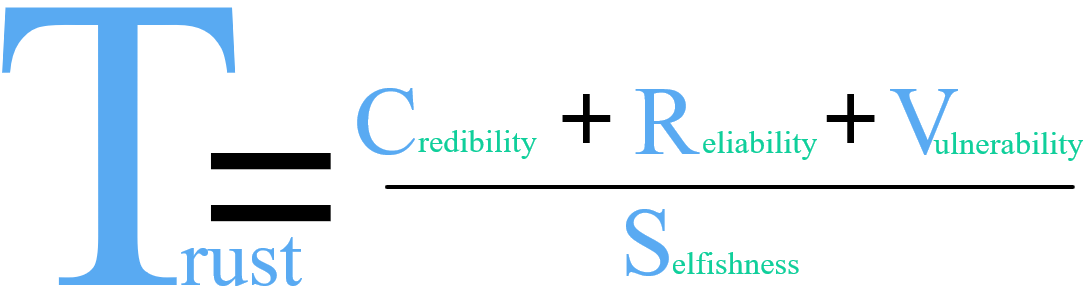
We have come to the most important variable when discussing trust. It’s in the denominator of the equation as well. This means that the larger this value the more it pulls down the other variables in the numerator.
We can be very creditable, reliable, and vulnerable, but if we are only doing this to help ourselves “WIN” we will actually “LOSE”. We will not be able to gain trust and sustain it if we are only out for our own gain. True we may be able to fake our selfishness for a little while to obtain short term gains, but trust is a long-term play. People will figure it out fast enough as selfishness is like a spotlight shining bright into the night sky. There is no way to truly cover it.
Selfishness tells people that we do not value them and do not care about them. Have you ever been around someone that you tried to give more and more trust and it just seemed to blow up in your face each and every time? It is really hard to keep wanting to extend them the benefit of doubt. After a while trust is just not an option anymore.
I had to come to this realization with someone that I have bent over backwards to help on quite a few occasions. Each time resulted in being taken advantage of due to their selfishness. I am very helpful by nature and want to help people from hitting some of the pitfalls that I have had to endure. This person was only focused on their wants without a care for anyone else.
Without getting into much detail about the situation, I was protecting something of value that would have gotten damaged to the point of costing thousands of dollars to repair as well as fixing some other components on that piece of equipment that were already broken. The person was supposed to assist as well and instead of helping, they showed up after everything was done and sailed off without a thank you. I have since had to make the decision to not help this person in the future. It is not something that I am happy about, but I have had to make that decision.
By being selfish we can quickly turn relationships sour. In sales or leadership if this happens, we really start losing influence. In sales and Leadership influence is the key ingredient to success. Without trust there is no influence. Leverage is a term of is a term often people use as an influencing tool of holding something over someone so that they will do what we want, but once leverage is gone these people will revolt! Ever here about Julius Cesar? His good friend stabbed him in the back. Now typically an actual stabbing does not happen in business, but there have been stories in business where boards have thrown the CEO out of the organization overnight. When we do not have trust, people will be less willing to give us the benefit of the doubt and promote us to customer. Even Steve Jobs was asked to step down at one point at Apple.
I am constantly taking inventory in my life to gauge how selfish I am being. I’m sure I fail to live up to my standard, but my focus is on not being selfish. Instead my focus is on trying to help everyone that I can. I put my expertise out there to help others gain knowledge. I do not do it so I can say that I have done it, but to share so that people can avoid mistakes that I have run into in the past. My goal is to help you become more efficient and successful especially with areas of sales and influence.
The key is to really take an inventory of our relationships and see if there are any areas where we are being a little selfish. Are there some relationships that we need to apologize for selfishness? Have we made any recent mistakes that an apology will help start the road back to building trust? Selfishness can be fixed when we take an honest look at how we have behaving with others.
So here it is the full Trust Equation.
Have a great weekend!
Sincerely,
Kevin Sidebottom
“Businesses wonder why the majority of their sales teams struggle at winning profitable business. I teach your sales team to walk with the customer through the five buying decisions, and in the correct order to generate more sales with high margins!”

You've Got The Purchase Order...Please Keep Going In The Sales Process!
Far too many sales people take the signed order and ride off into the sunset never to be heard from again. It’s a huge opportunity that unfortunately most sales people miss out on!
We’ve done it!
We have made it to the fifth and final buying decision for the customer which is “Buy”
The customer has now purchased our product / service and we celebrate! Unfortunately, this is where 99% of sales people stop the sales process. It’s okay to celebrate the win and I encourage the celebration, but when the sales person stops the sales process after receiving the order, the customer is left to fend for themselves. The customer soon will develop buyer’s remorse, not hitting the desired outcome from the purchase, and possibly thinking they were just sold something instead of purchasing a solution. The customer then associates sales people with that of someone that does not care about them.
Far too many sales people take the signed order and ride off into the sunset never to be heard from again. It’s a huge opportunity that unfortunately most sales people miss out on!
That’s right, when the customer agrees to buy, this is the time that sales professionals need to roll up their sleeves and move forward with the customer. The more this is done, the more the customer will brag to their friends, family members, social media, etc. about how awesome we served them and that everyone they know needs speak with us. Who wouldn’t want a salesforce of individuals selling of us without having to pay them?
I love having people that have taken my trainings tell others that they need to work with me because I know that what I am doing is helping!
First and foremost, when the customer agrees to purchase, they will second guess themselves (buyer’s remorse) about the purchase. That’s right, they are not sure what they did was the right decision. This typically happens for purchases over $50. We are not talking about a pack of gum here. The real-estate market has done a fantastic job overcoming this issue of “buyer’s remorse.” As soon as the customer agrees to purchase a property, they immediately begin moving the customer into the next steps.
When you confirm that the customer has made the right decision, they feel justified and will be set at ease. Getting the customer moving forward after this decision to buy and onto the next steps such as delivery date, onsite training, etc., the customer is reaffirmed and feels like they have made the best decision possible. They have a game plan for the next steps. The customer will feel relieved and begin moving forward with our help! They appreciate this, because most sales people do not do this! This simple step! Now we have a few other things we need to do as well.
The next thing we as professionals need to do is review how we did in the sales process. We do this to get better at selling our product / service. The better we do this the better we will get at the next sale and become more efficient. It’s like anything else we do. After every mission the best military operators will have a debrief meeting to discuss what went well and what could be done better the next time. The more we practice and review the more efficient we get. Take time to review spots that slowed us down and then fix those areas so that way we can move forward faster next time.
The last step in the sales process is crucial. Again 99% of sales professionals do not do this. This is the most crucial step in gaining influence with customers. It’s the next 90 days after the sale that really makes the customer’s purchase a success, or a failure. That’s right, after the installation and quick run through, the customer is going to have issues. The faster we communicate how to resolve those issues the better the customer will feel. That is why organizations have had support lines waiting for customer to call, but the sales professional has an opportunity to take this one step further.
This is the sales process step in trainings that most organizations ask a great deal of questions on how they can get better. It’s actually simple and to do once the content is created. That’s right, what content do you have available for the customer once they have purchased your product / service? Do you have a 10-steps to self-diagnose an issue? 15 best quick recipes for that blender? Youtube videos walking the customers through a new way to use the product / service? How about a Facebook group for other customers to share success stories and resolve issues together?
What do you have ready for your customers so that they can consistently win with your product / service? That is the question that we need to answer and if we do this well, we will be rewarded with greater levels of influence. With more influence comes greater growth in sales and increased revenue. At a certain point you become such an influencer that people stop focusing on price. Wouldn’t that be amazing to take the pricing discussion off the table?
We are in the service business no matter what we sell. Serve the customer well and reap the rewards. Underserve, and stay a commodity in the customer’s eyes.
It’s okay to have a little celebration, but then get to work rolling up your sleeves and help serve the customer!
Sincerely,
Kevin Sidebottom
“Businesses wonder why the majority of their sales teams struggle at winning profitable business. I teach your sales team to walk with the customer through the five buying decisions, and in the correct order to generate more sales with high margins!”

How Do you Get Past Buying Decision 1?
If we jump straight into selling mode after we get the customer’s name, we are failing the customer. Ever wonder why when asked what brings you in to this store today the customer says something like this, “Just looking…”
The first buying decision is the longest and hardest to complete for the customer. Mainly because there is so much decision making that has to happen in this buying decision before they can move forward. The customer has to know, like, and trust the sales person before the customer will ever buy from anyone selling a product / service.
We as sales professionals need to make sure we are answering these three questions for the customer in the first 60 seconds of meeting them:
Do I like you?
Do I trust you?
How can you help me?
If the salesperson gets your name and starts selling you something that they have, do you think they really care about your needs?
If we jump straight into selling mode after we get the customer’s name, we are failing the customer. Ever wonder why when asked what brings you in to this store today the customer says something like this, “Just looking…” It’s because the customer has been trained to think that sales people are all the same and all the sales person cares about is selling their product or service.
Let’s change that perception.
Let’s start by using a plan on how we will approach the customer in a way that builds likeability and trust. Let’s start with making sure when we approach the customer we are not circling like hungry vultures. Let’s let the customer come into our facilities and let them get comfortable by smiling and saying “Hi, welcome. We are here to help you when you are ready.” Smiling, wearing the right colors that psychologically reflect trust, honesty and lower anxiety. Not dark colored suits with power ties.
The environment we are in can affects our engagement levels. Things such as noise levels, smells, colors, lighting, etc. affect humans and can actually trigger anxiety. Do you think an anxious customer will be able to have a conversation and convey their needs? Have you ever noticed that department stores have different lighting, colors, music playing, and scents pumped into each area? That’s right they have studied customers to understand how to relax customers and to get them to stay in those areas longer. The longer someone is in the area the more likely they will buy a product / service. Remember that next time you get a free sample of food at Costco.
Now we can like someone, but still not buy from them.
There are two other questions that need to be answered as well. Do I trust you? and How can you help me? These two questions are very important with sales of $50 or more. People need to know like and trust us before they will do business with us.
If we can’t show the customer that they can trust us and that we are here to help them, the customer will simply go to another source and buy. It does not matter if we have the best product on the face of the earth. They need to trust us and know that we can help them.
So how do we do that?
By asking great questions. Asking questions is the way to get to know if what we have to sell will actually help the customer. Not just simple questions like, would the customer like a certain color of the product, but why are they looking to achieve with this purchase. What did they like about the last product they used, what do they wish they had on the previous product that they are replacing today? What does a win look like for the customer with this purchase?
Ask deeper questions to understand the why behind the customer’s decision
People crave to be understood and know that we are with them to help guide them on finding a solution. That is why customers talk to sales professionals. They are looking for guidance to find a solution to their needs.
Think back to the last time you had an amazing buying experience. What were some of the key elements of that sale that you had to tell your friends about because it just made you feel like you were set up for success with that purchase? How did the sales person make you feel? What did that salesperson do that stood out to you? What extra step did they do that no one else has ever done when you were making a purchase?
Now think of a bad buying experience? What were some of the reasons why the sales person lost the sale? What could they have done better? What made you run away as fast as you could to get away from that sales person?
If we do not get the first buying decision down correctly and constantly improve, then we will be mediocre in sales. No one really wants to be mediocre. If we want to be high achievers then we need to be constantly improving ourselves. We need to be focused on answering the three questions:
Do I like you?
Do I trust you?
How can you help me?
If you or your team need help reach out to me I am here to help!
Have a great day!
Sincerely,
Kevin Sidebottom
“Businesses wonder why the majority of their sales teams struggle at winning profitable business. I teach your sales team to walk with the customer through the five buying decisions, and in the correct order to generate more sales with high margins!”

Vulnerability is Crucial For Trust
I have worked with ex-navy seals, business owners, entrepreneurs, engineers, contractors, etc. The most successful people are vulnerable to those they need high levels of trust with.
Have you ever been told you are too vulnerable? My guess is that if you a man in your 40’s and older, that has not been something you have ever heard. It just was not modeled for the most part by our fathers. We were taught how to change the car oil, get a job, and fix things. Vulnerability was not something that most of us were taught.
I was raised in a single parent family for most of my younger years and being vulnerable was not a skill I was taught. I was taught to “man up”, “suck it up”, etc. We didn’t show emotion. Well we did show anger and sarcasm. That was about it. Vulnerability was something I work on daily. This was one of the hardest skills for me as a man, but one of the most beneficial assets as a person of influence.
You may be thinking, I don’t have time to be vulnerable. I just need to push through with my team or my customers and get the job done to move on to the next task. I understand business and getting work done. What I am talking about is building a trust with our teams or customers gives us the benefit of the doubt in bad situations. This kind of trust is more than the superficial arm-length kind of relationship. It brings people in to get to know us on a deeper level. A level that when the chips are down, they will step in to help without question.
Now let’s talk about what vulnerability is. Vulnerability is opening ourselves to be potentially judged, let down, hurt emotionally, and disappointed. Vulnerability is sharing details and emotions to show the real us. It is also an uneasy feeling when we disclose something about ourselves to someone in an effort to build deeper trust levels.
Vulnerability is deeper than honesty. When being honest, we can speak the truth, but still not build trust (just ask my wife). People can be rubbed the wrong way with honesty. We can not gain the connection with others when we are just honest. We need to develop our level of vulnerability with other individuals to gain deeper relationships. Vulnerability is a scary place for most people because there is that risk of being hurt, but the payoff is definitely greater.
I have worked with ex-navy seals, business owners, entrepreneurs, engineers, contractors, etc. The most successful people are vulnerable to those they need high levels of trust with. Leaders have to be vulnerable with those they lead. Leaders strive to grow the relationship with those around them so that when the time comes to dig deep, the leaders will have the buy in from those around them, and accomplish great things.
Take a look at the picture for this blog post. Those jets are flying a high rates of speed and crossing each other’s paths. Think they have high levels of trust to perform these stunts? The answer is yes. They also have to be in sink because one small mistake could end their lives. They need this deep level of trust in order to do this. They also have to be vulnerable enough when practicing to let others know their comfort levels.
The reason why I have had such great success in sales is because I am vulnerable with my customers and team members. I trust them and pushed through my comfort zone to allow others in to see who I am. By doing so I have gained great relationships and trust with those around me. Together we have accomplished great things like a men’s ministry, winning multi-million multi-year contracts, and solid relationships that have stood the test of time.
This week I want to challenge us to open up instead of trying to conceal things. It’s okay to show the real us to others. We can share some of the things we struggle with and ask for help. Being vulnerable with where we are at will allow us to grow stronger and have others come along side of us to accomplish much more. My commitment this week is to listen and be more vulnerable to those around me and not jump in to fix it and move on. What is the next step you can do today to be more vulnerable with those around you?
Have a great day!
Sincerely,
Kevin Sidebottom
“Businesses wonder why the majority of their sales teams struggle at winning profitable business. I teach your sales team to walk with the customer through the five buying decisions, and in the correct order to generate more sales with high margins!”