To Build Trust You Need To Have The Letter C
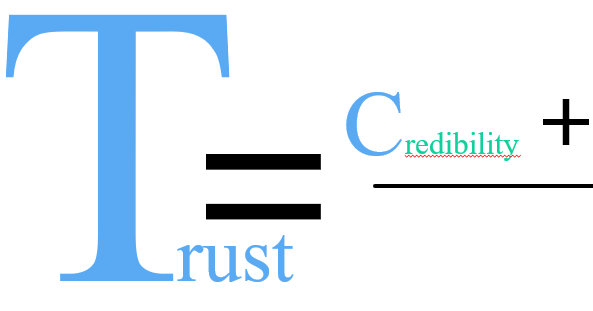
The last couple of weeks I have been helping you with understanding that there are different levels of trust needed for different levels of relationships and the three questions that we need to answer to build trust and influence. Today I would like help you with a concept that I created for people to visualize an easy way to understand what goes into trust. I call it the “Trust Equation” and it has helped many people start building trust easily by understanding the components of trust.
There are four main components of the trust equation and I will break down each of them in the next few blogs so that you can better understand each and excel at building higher levels of trust in 2022. Without trust we can’t make movements, sell, lead, or do anything of substance with others. We need trust.
Without any more delays let’s get into the first component of trust:
Credibility
We have have credibility before people will trust us on a specific topic of concern. This is crucial, but does not mean that we have to go to school to learn about everything and anything. No one knows everything.
Credibility is typically linked to knowledge. A person goes to school, gets a degree and then they are finally credible on a subject. While that is very true, there are other aspects to Credibility that many do not think about. One is effective communication and the other I call “being the bridge.”
I have seen very intelligent individuals lose credibility because they could not effectively communicate their topic. That’s right, just because they have a great deal of knowledge, does not automatically grant them credibility. Everyone needs to be able to communicate effectively!
There are many courses that help on effective communication topics, but the biggest effect on communication is the ability to break complex topics into simple understandable pieces. That means not using really big dictionary words when a simple word can be used. If we can communicate effectively then we can build trust and generate credibility.
Now the other component I mentioned earlier is what I call “being the bridge.” This is something that I learned when I first got into sales. If I was able to connect people needing help in a certain area with those that had the knowledge, I actually built credibility. That’s right because I was bridging the gap for them, then I am deemed a credible source as well.
When we bridge others together, we are associated with credibility because we are associated as one that adds vallue. Adding value is key in trust building and being a bridge will help us gain influence. This is one of the main ways I have been so successful throughout my career. I have built a great deal of credibility by bridging others together.
Bring knowledgeable, communicating effectively, and being the bridge will allow us to become more credible with others. Consistently showing up to add value and help others is the way to growing trust with anyone we interact with.
If you would like more information on building trust reach out and set up a call so we can discuss and I can point you in the right direction!
The next few weeks I will discuss the other variables in the trust equation. Look forward to helping you gain more trust and influence in the weeks to come!
Sincerely,
Kevin Sidebottom
“Businesses wonder why the majority of their sales teams struggle at winning profitable business. I teach your sales team to walk with the customer through the five buying decisions, and in the correct order to generate more sales with higher profits!”
https://www.amazon.com/Sales-Process-Uncovered-Success-Influence/dp/0578421518 - SPU Book
https://kevinsidebottom.kartra.com/page/5AF12 - Sales Process Uncovered Online Training
https://kevinsidebottom.kartra.com/page/68N10 - Trustworthy Online Training

Trust begins with three questions
If you want trust, you must answer three questions every time you meet with others. Too often people focus on how others will answer these three questions and not how we need to be answering them. The three questions are:
Do I like You?
Do I trust You?
How can you help Me?
Those three questions that everyone asks at every interaction are crucial for us to put our best foot forward. Otherwise, we will not grow trust levels with others and possibly erode trust with others.
The first question has a lot that goes into it, but the main thing is that if people do not like us then they will not trust us. There is a radar in our fight or flight system that has likeability as a key indicator. Ever have that feeling that something was wrong with someone you just met and you needed to leave. That is the radar trying to keep you alive.
Likeability is crucial. The colors we wear, the way we make others feel, our pace of speech, and even the scents we wear can affect the likeability factor. See we don’t know other people’s pasts, experiences, and triggers. That means that we can subconsciously step onto land mines that we did not know where there. A land mine is an explosive that is buried under the surface that when stepped on creates a large explosion usually killing the person that stepped on the land mine.
This does not mean that we just avoid contact with others. What we need to do is make sure we are consciously approaching those that we come in contact with awareness and humility. We can’t avoid contact with others, but we can however focus on understanding and help them.
The more we put the focus on learning about others and minimizing ways to trigger others the better we can build relationships with them.
When I first meet with others, I tend to wear colors like light blue, whites in my shirts. I don’t wear power ties, dark colors, or a ton of cologne. I also focus on learning about them by asking a great deal of questions. Not so I can sell them something, but to learn and help if possible. I want to help people and by investing in helping others, I have also benefited in my careers and personal life as a by-product.
The first step in taking the focus off ourselves and onto others is start by learning about them. The best way to do that is build a profile about them. That means we are focused solely learning about them (not to leverage them, but to help them). I use a profile sheet when I prep for meeting with individuals and do research on them prior to the meeting if possible. I have also asked if I could take notes and 9 times out of 10 the people are receptive and actually get more engaged by me attempting to learn about them.
I have attached a link to the profile sheet I use to learn about others a. If you’d like a copy just click here and you can have it. No, I am not trying to track your email through this. It is free to you. There are some questions you might have on this sheet so if you haven’t read any of my blog posts about the client profile sheet you can look back at those, or reach out. I would be glad to help you.
For today, focus on not stepping on land mines and learning about others and you will start building trust with others.
Have a great week.
Sincerely,
Kevin Sidebottom
“Businesses wonder why the majority of their sales teams struggle at winning profitable business. I teach your sales team to walk with the customer through the five buying decisions, and in the correct order to generate more sales with high margins!”
https://drive.google.com/file/d/1lWIVasmkFsoYL4h0AqIZgH6LC3qaw_gI/view?usp=sharing – client profile sheet
https://www.amazon.com/Sales-Process-Uncovered-Success-Influence/dp/0578421518 - Book
https://kevinsidebottom.kartra.com/page/5AF12 - Sales Process Uncovered Online Training
https://kevinsidebottom.kartra.com/page/68N10 - Trustworthy Online Training

How Trust Works
I hope you are doing well this week and ready to move forward with others that you interact with. In order to do that we need to make sure we are elevating the trust levels with those we interact with.
In order to do that we really need to understand how to build trust, why others give us some trust levels of trust, and what effects trust over time. Even though some people say they just give people trust when they meet them, would they trust someone to hold them a high rise building with just a rope?
We give some levels of trust to people, but don’t typically put our lives in their hands right away, unless there is some kind of emergency. I have made a diagram for trust levels that is in the picture of this post above. This gives an idea that the closer we are to people the more trust that is needed. That is why we do not have as many people in intimate relationships with us like our significant other and children.
We would not tell the world our deepest secrets like we would those in intimate relationships with.
That means that we have different levels of trust and we have to grow trust with others if we are going to learn more about them. Not to leverage them with their secrets, but to learn about them. Sales professionals for years have learned how to build rapport with customers and grow the relationships as well as trust levels. Sales professionals know that if business transactions are going to occur then there must be high levels of trust established.
Investments of trust take a lot of work and we need to be ready to do the work to grow trust. People will only interact with those they know, like, and trust. So, in order to build trust, we need to answer three questions on every interaction.
Do I like you?
Do I trust you?
How can you help me?
In order to build trust levels, we need to focus on these three questions and what I can tell you is the techniques that sales professionals use (not the sleazy ones) will help you understand how to do this effectively.
I would encourage you to pick up a sales book, or take and online training to help yourself learn and equip yourself to succeed in growing trust with others.
If you’d like to use mine that is great, but not a necessity. My links are below for my book “The Sales Process Uncovered” and the link to my trainings are also below:
https://www.amazon.com/Sales-Process-Uncovered-Success-Influence/dp/0578421518 - Book
https://kevinsidebottom.kartra.com/page/5AF12 - Sales Process Uncovered Online Training
https://kevinsidebottom.kartra.com/page/68N10 - Trustworthy Online Training
Sincerely,
Kevin Sidebottom
“Businesses wonder why the majority of their sales teams struggle at winning profitable business. I teach your sales team to walk with the customer through the five buying decisions, and in the correct order to generate more sales with high margins!”

Influencer or Influence, What Do You Want?
Have you ever thought about how to build influence in your marketing efforts? Have you ever thought about using an influencer to endorse your product / service to gain more customers?
Marketing has made a shift in the past few years relying on those social marketing influencers to endorse their products / services. Marketers believe that followers of these influencers will buy whatever that influencer has mentioned. Unfortunately, there is a limit to this theory?
By using an influencer, we are essentially using social proof with customers. That is the basis of gaining trust from someone else’s endorsement that others trust their recommendations. It’s literally a exchange of trust. This will work for commodities, but if you are offering a service, you may find it difficult to capitalize with this type of marketing.
When it comes to influencers, they hold up products, but to show how a service works it may be difficult and take time for them to really show how it works. When getting our marketing plans secured, we really need to understand what we are offering before we just throw money at the effort. If we believe we have a commodity then we have already lost because a commodity is only differentiated by price. That is why we need to make sure we have figured out how we are different from others in our same product / service demographic.
Successful organizations that have focused their efforts on customer service have secured reoccurring customers. That’s right the customer experience is more impactful than having a super star wear our products. We need to focus on building customer service and trust with our current customers and yes this takes time. We live in an era with two-day shipping, moves on demand, and grocery shopping online world, but the one true way to gain reoccurring customers is to serve them consistently over time.
Ever try to get a chicken sandwich from Chick-Fil-A at lunch or dinner? It’s a chicken sandwich, not a new cure for cancer, but because they have focused on customer service over time, they have passed up the other fast food competition with fewer locations. That’s right the golden arches which have been a staple were passed by Chick-Fil-A. Their customer service has accomplished this cult following.
We need to focus on the long-term vision of building trust with our customers. Without trust we will not gain influence with our customers. We need to have high levels of trust with our customers before they will tell their closets friends and family members to use us. That is also still the best form of referral. I am also not talking about bribing the customers with a coupon if they share with others.
I am talking about natural raving customers that can’t help but tell others to do business with you.We need to serve our customers well consistently if we are going to having reoccurring customers and eventually partners that will only buy from us and all that we sell. Wouldn’t it be nice to not have to market because our customers are buying everything we sell and partner with us?
That is why I consistently post blogs every week for over three years and consistently post videos online to help customers gain more knowledge and understanding about sales and influence. I am here as a guide to help you become successful in your endeavors.
Sincerely,
Kevin Sidebottom
“Businesses wonder why the majority of their sales teams struggle at winning profitable business. I teach your sales team to walk with the customer through the five buying decisions, and in the correct order to generate more sales with high margins!”

Why You Need Customer Trust
Have you ever bought something from a salesperson you just didn’t like or trust? If you did, how did it make you feel afterwards? When is the last time you made a large purchase from someone you didn’t trust? Likely never.
Today we are talking about why building trust with the customer is important.
There are three questions that everyone asks themselves about us when they meet with us. Every time! These questions are:
Do I like you?
Do I trust you?
How can you help me?
See that second question? Trust is a highly important question that has to be answered by us for the customer. If we don’t answer that question with our actions and words lining up, then the customer will move on down the road to our competitors that offer similar products / services.
Trust is extremely important with most of our major decisions. I define major decisions as decisions that cost over $500, or life changing decisions. Some use gut feelings, some use research, and some use advisors. The fact remains that trust is a part of every major decision. If we do not have trust, we do not act. This is why most consumers ask friends and family who they should talk to about a product / service. They are searching for a trusted advisor.
Today it is so easy to find options for a product / service that we need. Just hop online and do a quick search. When the customer is coming in to talk to us, they are trusting that we will help them. We need to make sure that we have that in mind when we serve the customer. We as sales professionals need to be showing up to serve the customer and being open and honest of where we can and can not help them. Focusing on how we can better grow the relationship and trust with that individual / organization.
Customers are not just looking for a transactional experience. They want to be known and heard. They want people that will advocate for them to find solutions that will benefit them the best. Customers want a relationship. We as humans are born to crave a sense of community and value. Customers want that as well. Why do you think there are so many Facebook groups out there today? People want community.
When people trust us, they share more information with us. Not their deepest darkest secrets, but they will share more and more as trust is built. I have had customers tell me about future RFQ’s that I could look forward to and worked with my teams to be more prepared so I was able to achieve success. That would not have happened had I not built great levels of trust with these customers.
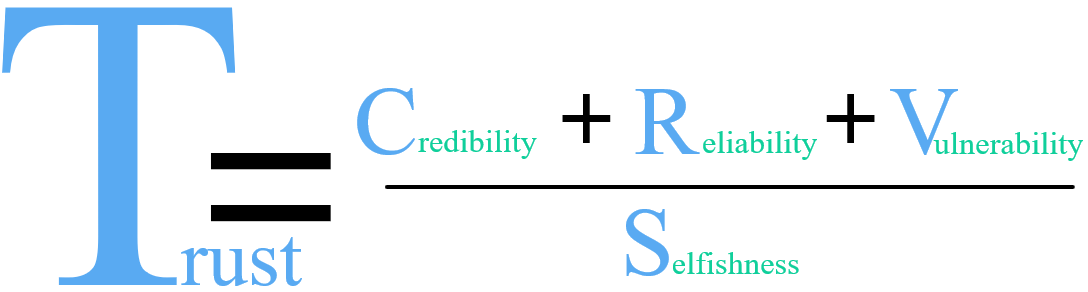
To build trust I use a simple equation that I call the Trust Equation. It uses variable such as credibility, reliability, vulnerability, and selfishness and puts them into a simple equation to help us build trust effectively and quickly with customers. This equation also focuses on a long-term approach to building a great amount of influence with the customers.
Now, there is a great deal to discuss on trust such as how to build it, the different levels of trust needed depending on proximity to others, and how to keep growing trust. That is why I created the “Trustworthy” training to help people like yourself understand and build trust quickly.
If you’d like to check out it click here to be taken to the training. It’s worth the investment.
Today, lets make sure we are focused on building trust with our customers.
Build trust with your customer and you will reap greater rewards!
Sincerely,
Kevin Sidebottom
“Businesses wonder why the majority of their sales teams struggle at winning profitable business. I teach your sales team to walk with the customer through the five buying decisions, and in the correct order to generate more sales with high margins!”

Why Trust In The Workplace Is Essential
Ever have a team that did not have trust? Ever work with others that would step on you just so they could shine brighter and show off their awesomeness? Ever been sabotaged by another team member to make you look bad?
Unfortunately, sometimes have these situations which makes us question if we in fact actually on a team?
There are many factors that go into trust in a team. We have to trust that team members will be able to do their job well, we have to trust they will not sabotage us, we have to trust things will be communicated effectively.
If we are a manager that does not have trust for our employees then we are going to micro manage them. If we do not trust the employees, we spend much of our time checking and rechecking their work. If we do that, how can we continue to grow ourselves, and still move the group forward? It’s like rowing a boat with our hands instead of an oar.
If we do not trust our colleges enough then we are doing extra work as well to make sure we hit the outcome we desire. That means more stress, longer hours, less efficiency, and drain on our attitudes. Then comes the mixed emotions of stress and disengagement with work and family. When teams are not in a high trust environment, they are not working efficiently. People are not communicating well and issues are sometimes hidden. The only time management sees an issue is when a major event occurs.
If we are in a large organization and the engineering team is not trusted by other teams, then the design will be delayed to launch. If this is a publicly traded entity and launches are delayed guess what happens to the stock price valuation…
We need to make sure we are forming a trusting environment because speed and cost are the two variables in business that are affected by trust. When we are in a high trust environment speed goes up and cost goes down. When that happens, guess what happens to profits…they go UP!
When we are in a high trust environment people will be allowed to move quicker without having to get tons of approvals and tons of double checking. Everything flows faster and work is completed with less bureaucracy. It’s like a river that is allowed to flow, it is clean, but when it is blocked up, everything becomes stagnant and scummy.
We need to make sure that we are working on ways to build trust throughout our organization so that we can work more efficiently. If trust grows, the outcome will be increased profits.
If you’d like to know ways to improve trust, check out this link that will take you to my training on building trust that will allow you to build trust around you and form great levels of trust with your teams.
Kevin Sidebottom
“Businesses wonder why the majority of their sales teams struggle at winning profitable business. I teach your sales team to walk with the customer through the five buying decisions, and in the correct order to generate more sales with high margins!”

Avoid This if You Want Trust
Ever been told you are being selfish? Ever tried to take a toy away from one child to give it to another? The response is most likely “It’s Mine…” We are born selfish which is why sometimes it is hard to build trust with others.
We have come to the most important variable when discussing trust. It’s in the denominator of the trust equation as well. This means that the larger this variable is, the more it pulls down the other variables in the numerator. Yes it is math based.
We can be very creditable, reliable, and vulnerable, but if we are only doing this to help ourselves “WIN” we will actually “LOSE”. We will not be able to gain trust and sustain it if we are only out for our own gain. True we may be able to fake our selfishness for a little while to obtain short term gains, but trust is actually more like a marathon. People will figure it out fast enough as selfishness is like a spotlight shining bright into the night sky. There is no way to truly cover selfishness.
Selfishness tells people that we do not value them and do not care about them. Have you ever been around someone that you tried to give more and more trust and it just seemed to blow up in your face each and every time? It is really hard to keep wanting to extend them the benefit of doubt. After a while trust is just not an option anymore.
I had to come to this realization with someone that I have bent over backwards to help on quite a few occasions. Each time resulted in being taken advantage of due to their selfishness. I am very helpful by nature and want to help people from hitting some of the pitfalls that I have had to endure. This person was only focused on their wants without a care for anyone else.
By being selfish we can quickly turn relationships sour. In sales or leadership if this happens, we really start losing influence. Influence is the key ingredient to success in sales and leadership. Without trust there is no influence. Leverage is a term of is a term often people use as an influencing tool of holding something over someone so that they will do what we want, but once leverage is gone these people will revolt! When we do not have trust, people will be less willing to give us the benefit of the doubt and promote us to customer. Even Steve Jobs was asked to step down at one point at Apple.
I am constantly taking inventory in my life to gauge how selfish I am being. I’m sure I fail to live up to my standard, but my focus is on not being selfish. Instead, my focus is on trying to help everyone that I can. I put my expertise out there to help others gain knowledge. I do not do it so I can say that I have done it, but to share so that people can avoid mistakes that I have run into in the past. My goal is to help you become more efficient and successful especially with areas of sales and leadership.
The key is to really take an inventory of our relationships and see if there are any areas where we are being a little selfish. Are there some relationships that we need to apologize for selfishness? Have we made any recent mistakes that an apology will help start the road back to building trust? Selfishness can be fixed when we take an honest look at how we have behaving with others.
When we lower selfishness relationships and influence seem to increase at a rapid pace. We need to place value on others and not do anything to just advance ourselves, but humbly help others get to where they need to go. “You can have everything in life you want, if you will just help other people get what they want.” Zig Ziglar
So here it is the full Trust Equation.
Sincerely,
Kevin Sidebottom
“Businesses wonder why the majority of their sales teams struggle at winning profitable business. I teach your sales team to walk with the customer through the five buying decisions, and in the correct order to generate more sales with high margins!”

Don’t Fear The V
How hard is it for you to share your true feelings of fear? Ever informed someone that you were uncomfortable? Have you ever been told you are too vulnerable?
My guess is that if you a man in your 40’s and older, that has not been something you have ever heard. It just was not modeled for the most part by our fathers. We were taught how to change the car oil, get a job, and fix things. Vulnerability was not something that most of us were taught.
I was raised in a single parent family for most of my younger years and being vulnerable was not a skill I was taught. I was taught to “man up”, “suck it up”, etc. We didn’t show emotion. Well we did show anger and sarcasm. That was about it. Vulnerability was something I work on daily as I enter my fourth decade of life. This was one of the hardest skills for me as a man, but one of the most beneficial assets as a person of influence.
You may be thinking, I don’t have time to be vulnerable. I just need to push through with my team or my customers and get the job done to move on to the next task. I understand business and getting work done. What I am talking about is building a trust with our teams or customers gives us the benefit of the doubt in bad situations. This kind of trust is more than the superficial arm-length kind of relationship. It brings people in to get to know us on a deeper level. A level that when the chips are down, they will step in to help without question.
Now let’s talk about what vulnerability is. Vulnerability is opening ourselves to be potentially judged, let down, hurt emotionally, and disappointed. Vulnerability is sharing details and emotions to show the real us. It is also an uneasy feeling when we disclose something about ourselves to someone in an effort to build deeper trust levels.
Vulnerability is deeper than honesty. When being honest, we can speak the truth, but still not build trust (just ask my wife). People can be rubbed the wrong way with honesty. We can not gain the connection with others when we are just honest. We need to develop our level of vulnerability with other individuals to gain deeper relationships. Vulnerability is a scary place for most people because there is that risk of being hurt, but the payoff is definitely greater.
I have worked with ex-navy seals, business owners, entrepreneurs, engineers, contractors, etc. The most successful people are vulnerable to those they need high levels of trust with. Leaders have to be vulnerable with those they lead. Leaders strive to grow the relationship with those around them so that when the time comes to dig deep, the leaders will have the buy in from those around them, and accomplish great things.
The reason why I have had such great success in sales is because I am vulnerable with my customers and team members. I trust them and pushed through my comfort zone to allow others in to see who I am. By doing so I have gained great relationships and trust with those around me. Together we have accomplished great things like a men’s ministry, winning multi-million multi-year contracts, and solid relationships that have stood the test of time.
This week I want to challenge us to open up instead of trying to conceal things. It’s okay to show the real us to others. We can share some of the things we struggle with and ask for help. Being vulnerable with where we are at will allow us to grow stronger and have others come along side of us to accomplish much more. My commitment this week is to listen and be more vulnerable to those around me and not jump in to fix it and move on. What is the next step you can do today to be more vulnerable with those around you?
Have a great day!
Sincerely,
Kevin Sidebottom
“Businesses wonder why the majority of their sales teams struggle at winning profitable business. I teach your sales team to walk with the customer through the five buying decisions, and in the correct order to generate more sales with high margins!”

Why Trust starts with the letter C
Trust is in high demand today.
Some would say that it is harder than ever to build trust with others. Far too often people let us down and keep moving on as if they don’t even care. It’s not true, but that is what our feelings tell us. Trust is a very expensive commodity. Businesses can lose large accounts because of trust. CEO’s are let go for violating trust.
Employees and management need to establish trust more than ever especially with the working remote situations. In uncertain times, it is trust that is the key ingredient in moving forward and achieving desired goals.
There are many aspects to trust and how to build high levels of trust. Different environments also require different levels of trust. I have been asked many times for a simple roadmap in building trust. Something simple for people to remember and be able to apply. I have also spoken to Multi-Billion dollar organizations to help teams build trust by using this equation. That is why I have created the Trust equation.
For today let’s focus in on “Credibility.” Yes we need credibility to be able to build trust. Ever read an article that states I had a credible source? Credibility actually has a few components to it and some that most people don’t think about.
Credibility is typically linked to knowledge. A person goes to school, gets a degree and then they are finally credible on a subject. While that is very true, there are other aspects to Credibility that many do not think about. One is effective communication and the other is what I call call “being the bridge.”
I have seen very intelligent individuals lose credibility because they could not effectively communicate with others. That’s right, just because they have a great deal of knowledge, does not automatically grant them credibility. Everyone needs to be able to communicate effectively! There are many courses that help on effective communication topics, but the biggest effect on communication is the ability to break complex topics into easy to understand language. That means not using really big dictionary words when a simple word can be used. If we can communicate effectively then we can build trust and generate credibility.
Now the other component I mentioned earlier is what I call “being the bridge.” This is something that I learned when I first got into sales. If I was able to connect people needing help in a certain area with those that had the knowledge, I actually built credibility. That’s right because I was bridging the gap for them, then I am deemed a credible source as well. When we bridge others together, we are associated with one that adds value. Adding value is key in trust building and being a bridge will help us gain influence. This is one of the main ways I have been so successful throughout my career. I have built a great deal of credibility by bridging others together.
Knowledge, communicating effectively, and being the bridge will allow us to become more credible and help others trust us more.
If you’d like to learn more about trust and the trust equation I have a click here for my online training.
Have a great day!
Sincerely,
Kevin Sidebottom
“Businesses wonder why the majority of their sales teams struggle at winning profitable business. I teach your sales team to walk with the customer through the five buying decisions, and in the correct order to generate more sales with high margins!”

How Good Is Your Why When Goal Planning?
Ever wonder why 80% of new years resolutions fail? Ever wonder why your team just doesn’t seem to hit goals? Why do most people not even set goals?
The main reason is that growth whether it be personal, professional, or physical is painful. Growth is not easily achieved which is why there are so few people achieving the next level results.
I recently took my son to the orthodontist to start his journey for a better smile while getting braces installed on his teeth. He asked me what it was like since I had them twice. Yes, it typically takes me double to achieve results than most people 😊 I told him that the initial process is not very hard as they apply the torture devices to your teeth, but that he should expect to have a 6 out of 10 on the pain scale for his teeth for the following few days.
His response was that he was okay just not getting braces. He didn’t care that it would improve his smile, or fix some issues in his mouth that would help him. He just wanted to avoid pain and discomfort. It dawned on me in that moment that I am not alone. I don’t always want to do the hard things because it will cause me discomfort.
Most individuals will avoid pain at all costs to live an comfortable lifestyle. What I’ve learned is that nothing worthy is every easy. There is some level of pain and risk associated with any worthy venture.
If we want to grow financially for most cases, we need to gain education, work hard, and budget. None of this seems fun or comfortable either. My mother always said, “ nothing ventured, nothing gained.” I added to that that no pain, no gain. Okay I may have borrowed that from some weight lifter somewhere.
If we want to grow, we need to put in effort and accept levels of discomfort / pain. When we want to gain muscle, we are actually ripping apart muscle strands during weight lifting exercises that repair themselves when we are sleeping that increases their size. The same is true with anything we want to grow in.
We must accept that we will have some levels of pain to grow ourselves in whatever venture we take on. We need to review our why and figure out the cost of achieving that why. If the why is not greater than the costs, then we will have no chance at success.

We should be adding to the process of goal setting what our why is next to each of our goals to decide if this is a good goal or not. Otherwise, we are just hoping that we will make it and likely will fail to hit that goal.
Over the pandemic I had to review quite a few things I wanted to do with my business and had to go through quite a few pain points when I created all my videos, online trainings, marketing ideas, and personal decisions like losing weight.
Each and every one of these things required me to sit down and figure out my why. If I had a great why I have achieved my goal, but if my why was small or something superficial, I did not achieve that goal.
If you have a goal for yourself, it is a great step to review your why before setting out the goal. Yes, we need to make goals that are easy to understand and measurable, but we also need to make sure we factor in the pain level we will have to endure to make these goals possible before we set out. We risk a higher levels failure when things get tough if we have not done this planning.
As we are heading into the fourth quarter of 2021 lets start reviewing our goals that we created for the year and understand why we failed at some and why we succeeded at others. The why will be a great area of focus.
If you’re curious I did lose quite a bit of weight during 2021 by dieting which was very painful, but worth it!
If you have any questions, or would like to discuss this topic more, feel free to reach out, I’d be glad to have that conversation.
Have a great day!
Sincerely,
Kevin Sidebottom
“Businesses wonder why the majority of their sales teams struggle at winning profitable business. I teach your sales team to walk with the customer through the five buying decisions, and in the correct order to generate more sales with high margins!”

Making Great First Impressions
Hello Everyone!
Ever wonder why some people just seem to be able to make great impressions on others while others don’t? Ever struggle to make a great first impression yourself?
I have been thinking about this topic for a while now and decided that it was time to step up on my soap box. I firmly believe that we all need to know how to sell in order to make great first impressions. Whether we are going for a job interview (selling ourselves), out on a date (selling ourselves), leading an organization (selling vision and ourselves), or selling a product or service which means we need to know how to sell (ourselves), etc.
No matter what we are doing, we are selling ourselves as the best option for those around us. We share stories, build friendships, engage with coworkers etc. all of the time. Some people do this really well and some unfortunately do not. This is not simply determined if you are an introvert, or an extrovert to determine if you will do this well. What I am saying is that some just don’t sell themselves well enough.
There are three questions everyone asks at every interaction and they are as follows:
Do I like you?
Do I trust you?
How can you help me?
In seven seconds, a perception is formed about the other person based off these three questions. Now there are so many aspects to how one can affect those three questions, that it is key that we know how to sell and why these three questions are affected. Learning the sales process if even just for only buying decision 1, we are definitely on solid footing to move forward with other people.
How we are dressed, what environment we are in, our posture, our speech patterns, and many more aspects affect how people form their decisions about us. Have you ever heard the phrase. “we only get one chance to make a first impression?” This is because once someone makes that impression about us, it is extremely hard to change.
The sales process is the key to mastering the art of first impressions, building rapport, and likeability. Once we master the first buying decision of the sales process, we can build rapport with those around us faster! This will enable us to make great first impressions, obtain engagement from those around us, and create stronger relationships.
Wouldn’t it be nice to know how to sell and build relationships to make our lives better?
If you’d like to learn the sales process and how to gain influence, I have launched my online courses. It will enable you to master sales, implement the simple to use process, and become a top performer as well as how to build great levels of trust quickly.
Below are the two links to my online trainings to help you build rapport and influence with others. Both can be completed at your own pace and in the comfort of wherever you have a an internet connection.
Have a great week!
Sincerely,
Kevin Sidebottom
“Businesses wonder why the majority of their sales teams struggle at winning profitable business. I teach your sales team to walk with the customer through the five buying decisions, and in the correct order to generate more sales with high margins!”

How to build trust with employees continued. ..
Last week we talked about why leaders need to focus on building trust with their employees if they want to move forward, have engagement, and a good culture.
If you did not have a chance, go back and read last week’s blog on why we as leaders need to make sure we build relationships with our employees if we want to move forward faster with them.
On to why we need to think like sales professionals if we want to gain influence with our employees. Sales professionals are trained to gain influence and how to build relational collateral with people. I like to think of influence and relational collateral as a bank account. Consistent deposits over time gains great levels of influence. Constant withdrawls without deposits results in a bad relationship.
People will not buy from people they do not know, like, and trust. If we want employees to buy in to what we are wanting to do, then we need to make sure we are focused on them.
You may be wondering how we focus in correctly. It’s actually pretty simple and starts with three questions that the employee is asking about their leaders.
Do I like you?
Do I trust you?
How can you help me?
These three questions seem very selfish right? We all go into this thought process every time we meet another individual. It is hardwired into our brains for survival. When mankind was hunting and farming with their community they needed to know if they could also trust those around them. No one really wanted to get eaten by a saber toothed tiger right?
As a leader we need to be outward focused so we need to narrow in on these three questions and how we can answer them well for each and every employee that reports to us. If we can’t answer any of these questions, then we will not gain influence and engagement from our employees.
The next question you are probably are asking as you read this is how do we answer these three questions? We need to sit down and ask questions of the employees. That’s right, we need to be asking questions to understand our employees. People want to be understood and known. How do leaders do that? They ask questions.
Three main types of questions: Situational, Issues, and Ramifications kind of questions.
We need to understand where our employees are at, what issues they are facing, and what are the ramifications if those issues are not resolved. That is why when meeting with employees we should be using the same CRM that we use for our customers. We should be constantly learning about our employees. Not to leverage them, but to know them and their situation. By knowing where they are and what they are struggling with we will be able to help with solutions. By doing this we build influence and engagement as a biproduct.
If we do not and simply focus on getting a job done, we will see turn over, lack of engagement, and slow downs in work which end up driving higher costs eroding our profits. It is to our benefit if we take time to understand our employees and learn about them to help them. If we do so, we will be rewarded with what Dave Ramsey says, “They will charge the pits of hell with a water pistol for us,” if we show employees we care about them.
Have a great day!
Sincerely,
Kevin Sidebottom
“Businesses wonder why the majority of their sales teams struggle at winning profitable business. I teach your sales team to walk with the customer through the five buying decisions, and in the correct order to generate more sales with high margins!”

Why Some Leaders Are able to Gain Influence and Trust, While Others Don’t
Good morning everyone,
I hope you are doing well and have been learning through my blogs and youtube videos to gain influence with your team members and customers. Today I’d like to talk about why some leaders are great at building trust and influence with people while others just don’t.
Ever have a manager that made you feel like you could do anything and you would fight for them to your last breath? Chances are that you would not go that extreme, but you stayed at your current job because they were a great leader.
The majority of managers are focused on keeping people and process moving steady and having the least amount of push back for the organization. They want to stick around for a pay raise, or a position raise inside the organization. These same managers push for their team members to keep moving along and getting their jobs done while hoping to not have to keep replacing people which slows everything down.
Very few leaders take it upon themselves to truly work on building influence with their team members and focus on helping their team members be successful. When we as leaders turn the focus off ourselves and what we need to how we can help our team succeed, that is when amazing things start to happen. Buy in goes up, people stay around longer, they even work harder, engagement increases, etc.
Culture, engagement, influence, and a whole bunch of high energy words are thrown around as focus points, but here is the simple thing that leaders need to do to achieve great results with their teams. Leaders need to answer three questions on a daily basis to their teams.
Do I like you?
Do I trust you?
How Can you help me?
These three questions are what the team members are asking each and every time they interact with each other. If trust is low, and the members believe they are just a number instead of a team member that is when people start lacking energy at work and looking for other avenues of employment. Leaders need to really understand this. If they want to retain employees, and have a culture of growth, the focus needs to be how leaders can help the team grow.
For those that say, what if I invest time, energy, and money which results in the future, the employee leaving…What if we don’t and they stay with lack luster effort?
When trust is high speed goes up and costs go down. That means that profits go up.
If Leaders are focusing on answer the three questions every time they show up with their team members, they will gain influence, gain engagement, and create a great culture. In this great environment people will know that they are valued and will go the extra mile day in and day out to make sure the mission is a success.
Have a great day!
Sincerely,
Kevin Sidebottom
“Businesses wonder why the majority of their sales teams struggle at winning profitable business. I teach your sales team to walk with the customer through the five buying decisions, and in the correct order to generate more sales with high margins!”

Want Influence? Focus On Rapport
Have you ever wondered why people just ignore your request?
Ever have someone work for you that consistently looks and acts disengaged until you pressure them for your request again?
Would you like to have people that are engaged? I think most of us would say yes to that right?
When I teach people about building greater levels of engagement and influence with those around them, I have to remind most of the people that it all starts with us. That is right if we don’t focus on building rapport then we shouldn’t expect others to step up? See people want to feel valued and by us investing into them, they will feel valued.
Whether we are coaching, are a boss, sitting with a client, interviewing, or anytime we encounter another person, we need to be able to build rapport quickly. People form their first impressions of others in less than 60 seconds. Two questions “Do I like you? and Do I trust you?” are answered in that 60 seconds. If we want influence, then we need to be able to answer those two questions quickly. That is why we need to have rapport.
People also associate with others that they know, like, and trust. I have even heard of people being hired because they were more relatable even though they were not the most qualified. Isn’t that interesting. Rapport building is an essential skill to have if we are going to interact with other people. Especially if we want to grow influence with those people.
So how do we build rapport?
Here are four ways that I build rapport with others:
Be Helpful
Be willing to help others with whatever I am capable to help with. Go the extra mile to help others even when we think we have done enough. One step further... It could be jumping in to help unload something that the person we are meeting with is trying to unload from a truck without trying to get something from them in return. It could also be helping sweep up a mess that has happened for the customer while they are trying to fill an order, or sending follow up note to the person that the task was completed for them by our organization. Being genuine and helpful will go a long way at building rapport with people. Not trying to leverage the interaction with others.
Be Intentional Curious
By being intentional curious I mean valuing others that you’d like to learn about them. This can be done by researching others on social media such as Linkedin, Facebook, local associations they are affiliated with, google etc. Being intentional to learn about those people and their interests are very impactful. Not just to gain leverage, but to be intentionally curious about them and hear them.
Be Respectful
People want to feel valued and that they are important. Why not make them feel that way? Let them know that we have their back and are willing to do the work with them. Call them sir or ma’am shows respect. Using their name (sweetest sound to any person is their own name), using our manners, asking them questions. By being respectful we are showing respect and who doesn’t like some R.E.S.P.E.C.T.?
Be Enthusiastic
Show some enthusiasm with the person we are talking to. Use humor, make them feel comfortable, and lower the anxiety. People that smile and make people laugh are far more enjoyable. These people build rapport more so than someone who walks around like the Winnie the Pooh character Eeyore that moped around and never showed excitement. People like to be around light hearted and fun people. Show some enthusiasm and energy. People gravitate towards others that are full of energy.
There you have it, think of H.I.R.E. when you are looking to build rapport. Focus on others and help them get to where they way to go, be respectful and be enthusiastic in order to build rapport. We want the person to like us so much that they can’t think of anyone else they would rather talk to for our subject matter.
If you are interested in building more influence follow click here to my course and I will guide you in the principals on how to answer the three questions that everyone asks at each interaction.
Have a great day.
Sincerely,
Kevin Sidebottom
“Businesses wonder why the majority of their sales teams struggle at winning profitable business. I teach your sales team to walk with the customer through the five buying decisions, and in the correct order to generate more sales with high margins!”

How Can I Help?
How often do we ask this question?
How can you help me is typically what we ask.
All of us by nature are born with the innate desire to find out how we can be helped by associating with others. Call it selfishness, survival, whatever you want to call it. We are born with this desire to find out how we will benefit by the interaction with another.
Our employees want to know how they will get to a better place by working for us as well. Just like us, they want to know how their lives will improve. It’s up to us to answer that question each and every time we interact with them. If we chose not to, then we will find ourselves losing engagement from our employees. We want to have people coming to us with ideas on how to improve, with engagement, with excitement to work with us!
The question we should be asking ourselves is what do we have in our capabilities to make the lives better? How by working with us will their lives be better? This is a crucial change in our focus. Instead of focusing on how we can benefit, we need to shift that focus onto how we can help. What is it that we, and our organization can do to help the employees flourish?
What do we have in our capabilities to enrich those that work for us and with us to improve their lives. Do we know what major events are going on in their lives and what capabilities we have to come along side them to help? We don’t need to get into tons of details, but if we knew someone lost a loved one, could other people in the group rally around to pick up some of the slack that will likely get dropped for a shot period of time?
One thing that I have strived to do is add value in each interaction. It doesn’t have to be monetary all the time. It can be helping the employees learn a new skill or software, ideas and local hot spots for a vacation, life hacks, deals, or helping them find toilet paper when the country is freaking out during a pandemic. Finding out what they need help with and stepping in shows that we value others and they will pick up on that.
The key is to take the focus off of wondering how we can capitalize from the exchange and how we can add value. I love the quote from Zig Zigler that says, “You can get everything in life you want if you will just help enough people get what they want.” It really works and the outcome is far greater than we would have expected. It is harder to accept something with a closed fist, but with an open hand more can be added.
Helping others when they need help will grow trust and influence to where they will run with us in the heat of battle for the cause. Engagement will increase and we will see more output with those that we help and value. Let’s focus on how we can help instead of what we can gain from an interaction. That will drive better results.
Have a great day!
Sincerely,
Kevin Sidebottom
“Businesses wonder why the majority of their sales teams struggle at winning profitable business. I teach your sales team to walk with the customer through the five buying decisions, and in the correct order to generate more sales with high margins!”

Why Should They Trust Us?
Today we get into the second question that employees are asking themselves when speaking to to leadership. Do I trust you?
That is a huge question that if answered No, can stop engagement in its tracks. If the employees do not trust the leadership then the organization is just going to be stagnant. Now if you have ever walked by a stagnant pool or water, what did you notice? There was likely a not so pleasant smell and algae growing on the top of the water. Would we want our organizations to become stagnant?
I have spent the majority of my career studying why people buy products and services as well as why people buy into leadership. Being that I was an engineer there had to be an equation to the solution. Magic was also not going to be the answer. What I found is that when people use humor, are upfront, and show empathy towards others. That is when people really start to open up and trust.
I’ve had a manager that had issues gaining trust. This manager would openly tell anyone he first met within the first few minutes about his Christianity, but his actions would contradict what he would say he stands for. He was explosive to be around and would demand you follow his view points. If you challenged his view points, watch out!
This kind of behavior erodes trust the same as lying to others. Trust is crucial for any kind of growth individuals
So how can we grow trust fast? Here are four principals that will help us grow trust with individuals.
1. Social Proof
2. Heart of a teacher
3. Open and honest communication
4. Encourage others to hold the microscope
Social proof is using a mutual connection between the someone else and yourself. So many people like Dr. Oz, Dr. Phil, music artists, etc would see huge followings after being on the Oprah show. Once they leveraged that connection, they were considered the go to expert. Now we can’t all get on the Oprah channel, but we can leverage anyone that we know who knows us well that could reach out on our behalf.
Having a heart of a teacher is offering help to the others get to a better place even if it does not benefit ourselves initially. Teaching to give free knowledge for the heart of helping others is something that is lacking in today’s culture. People tend to only want to help if they will receive something in return in that transaction. If we want to gain trust, we have to have a heart of a teacher to help others. Not for what we will gain, but to help. Zig Ziglar stated, that we will get all we want out of life, if we help enough other people get what they want. I love that concept!
Open and honest communication means reaching out when we see something bad coming, but also making sure that others are aware and that we have their back. Making sure that they are communicated to in a personal level is key. Pick up the phone when we can instead of just sending an email. This is something that I still struggle with sometimes when I am busy, but what I have learned is making sure I communicate is key. Keep in mind the written word it taken negative most times when someone reads it. Most of communication is nonverbal, posture, tone of voice, etc. An email does not have the same impact as a verbal, or in person conversation.
The last key thing to do is encouraging others to hold the microscope. No one is perfect so we should stop thinking we are. We should stop judging others by their actions and want ourselves to be judged by our intent. We should give others the opportunity to speak life into areas that we may have blind spots to.
There you have it. Four ways to grow trust fast. SHOE… We need to have our shoes on if we plan to walk the talk :)
Have a great day!
Sincerely,
Kevin Sidebottom
“Businesses wonder why the majority of their sales teams struggle at winning profitable business. I teach your sales team to walk with the customer through the five buying decisions, and in the correct order to generate more sales with high margins!”

Do You Like Me?
Good morning everyone. Last week we discussed the three questions that employees ask when the meet with us on every interaction. If you missed it click here to catch up.
The first question that we ask ourselves subconsciously when we interact with another person is “Do I like you?” Our brains are trying to figure out if this person standing in front of us is a threat or a potential ally. Should we stay, or run…
Physically our bodies will change posture depending on how this question is answered. Our posture will literally change as much as leaning in to leaning back depending on engagement and trust. This is why sales professionals have been taught to always mirror our customer’s posture during meetings.
Did you know that depending on if you are male or female you tend to want to stand in different postures when interacting? Women prefer to stand at 90 degree angles to men when they are interacting in the personal space. They naturally want to keep a guard up to not feel vulnerable. Men typically like to stand face to face total body facing their counterpart.
Are you starting to see how this might be a problem getting someone to like you if you do something small like use the incorrect stance?
Here is something else that will impact the way someone answers that question. The colors clothing we wear can also impact how we are judged. That’s right the color we wear actually has an impact on how others perceive us. We could start the discussion off on the wrong foot just by color. In Robert Cialdini’s book “Influence” he breaks down the colors and what they mean. It is a must read if you are working to sales! To make it easier for you, I tend to wear light blue and white shirts when I meet someone for the first time because those colors are associated with “Trust.” They are also calming colors. I want the customer calm and feeling like I am a trustworthy advocate for them.
I make sure to wear the right color tones for the meeting that I am about to have. The reason is I need the customer to feel at ease while meeting with me. They will be more relaxed and willing to hear me while we are discussing a topic. I also pay close attention to their posture as what I have learned is that 93% of communication is actually non-verbal.
Here are some other factors that can affect the first impression:
Scents we wear, voice tonality, pace of speech, jewelry, etc.
The old saying we only get one chance to make a first impression still is true today. Making sure we are paying attention to the person in front of us will help us greatly generate trust.
Have a great day! Next week will jump into the second question we need to answer.
Sincerely,
Kevin Sidebottom
“Businesses wonder why the majority of their sales teams struggle at winning profitable business. I teach your sales team to walk with the customer through the five buying decisions, and in the correct order to generate more sales with high margins!”
Employee Engagement Do We Really Need It?
Do you have any people that just don’t seem to engage in your mission, vision, or plan? Do they just seem to listen and then go back to what they were already doing?
Ever see people not paying attention during your meetings?
Chances are if you are in a large organization, you have witnessed this engagement issue. Even if you are under 100 employees, you may have noticed this as well.
There are a lot of reasons why people are disengaged and it slows the organization down. People become complacent and then slowly just show up to collect their paycheck. This starts to suck the life out of the organization.
Lack of engagement is a huge problem! So much that organizations spend millions of dollars booking keynote speakers, sending management into trainings, and still do not gain engagement from the employees. It’s a culture problem and the main solution is found by answering three questions:
Do I like you?
Do I trust you?
How can you Help me?
These three questions are asked in our subconscious every time we interact with others. Our bodies are hardwired to want to know if we like, trust, and can be helped by the other person. These questions have been embedded into our survival since the beginning of mankind. We also are programmed to know if we are safe in an environment, or if we need to run (fight or flight response).
In business, if we are not answering these questions for our employees then why should we expect them to engage? The people that report to us want to know that what they are doing has meaning and that they can like, trust, and be helped by us. This is deeper than just a pay check. These people want to know that we will be there to support them. Otherwise, we are just like any other organization they have worked for that has not cared for them with the only differentiating factor is the size of the paycheck. Enter employee turn over!
I have worked in various industries and business environments. The one thing that is common is that leaders can have all this enthusiasm and charisma, but still have engagement issues in their organizations. People just going through the motions and collecting a pay check. No enthusiasm, no going the extra mile for the team, and just showing up for their hours of work and then leave. No cool game area, sleep pods, or other fun things to do will fix this.
If we want to get engagement and people showing up for a cause, going the extra mile, and willing to charge into battle with us, then we need to make sure we are answering the three questions to each and every employee. We need them to like, trust, and know that we can help them. It’s a two-way street as they have to be able to answer those three questions with us as well. That is hopefully why we hired them.
Start by having a conversation with them and asking questions about what they need. They may not be able to correctly articulate everything they need, but at least they know that you care and you want to help. By showing you care and have empathy for your employees, they will start going the extra mile for you. Then as discussions evolve with employees, together there will be more buy in for the mission, vision, and goal of the organization.
People want to know they matter and that their leadership does actually cares about the employees before they will go all in for the mission.
The next few weeks we will break down the three questions and give you tips on how to actively hit the mark on each of them.
Have a great weekend!
Sincerely,
Kevin Sidebottom
“Businesses wonder why the majority of their sales teams struggle at winning profitable business. I teach your sales team to walk with the customer through the five buying decisions, and in the correct order to generate more sales with high margins!”

Simple Ways to Keep Learning as a Leader
Today’s blog post is written by Curtis Fisher from www.tradesbright.org.
I hope you enjoy it!
The best leaders are always learning. As Harvard Business Review explains, engaging in lifelong learning is loaded with benefits, personally and professionally. Career-wise, those who continue to learn and grow can ensure ongoing financial success as work becomes more technologically-oriented. On a more personal level, pursuits like reading are wonderful stress-busters, and problem-solving can be extremely fulfilling. Some types of learning, such as playing a musical instrument, can even help to counteract cognitive decline. And living in a manner that is open and curious can be a boon to your social and networking efforts.
Some of the greatest successes of our time — Bill Gates, Warren Buffet and Barack Obama — made lifelong learning part of their formula for success. It should also be part of yours. Here are some great resources to get you started!
Enroll in Online Programs
You don’t have to quit your day job to further your education. Look for remote learning opportunities through online courses and programs.
● Sign up for a leadership program from Kevin Sidebottom to learn how to be a conscious and purposeful leader.
● Earn your business degree from an online university that offers flexible courses.
● Take a course through your local small business administration (SBA).
Listen to Podcasts and Audiobooks
Podcasts and audiobooks, like the ones listed below, are great for learning while you’re commuting to work or doing the dishes.
● The TalentGrow Show podcast.
● The Leadership Biz Cafe podcast with Tanveer Naseer.
● Biographies and autobiographies about the most successful business leaders of our time.
● Leadership books recommended by the world’s top entrepreneurs.
Read Online Articles and Guides
You can learn almost anything online. These are some great articles that every leader should read at least once:
● How to avoid micromanaging your employees.
● A distilled list of the top leadership traits of great leaders.
● Understanding the difference between being a boss and being a leader.
● Articles that have inspired other successful leaders.
Become a Teacher
One of the best ways to learn is to teach someone else! Consider mentoring someone, launching a blog, or creating your very own course.
● Become a mentor to a first-time entrepreneur.
● Create a blog or a website where you can share your knowledge.
● Produce informative and engaging YouTube videos.
No matter how long you've been working in your leadership role, you can always benefit by learning something new. Even the most successful leaders can find room for improvement! Keep learning by seeking out articles, podcasts, books, courses, and coaching programs that will help you reach your full potential.
Are you looking for leadership coaching? Kevin Sidebottom can help you acquire the skills you need to thrive as a leader!
By Curtis Fisher
photo by pexels

Want Influence? Understand Their Needs!
Last week we talked about C.I.A. and how using these three letters are essential in growing influence. Today we are going to really grow our influence with those around us. Today we are going to find out the needs.
Whether it is a customer, a team we lead, or the nonprofit we are in charge of. We need to truly understand the needs of those around us. Deeper needs than just food, water, clothing, and a paycheck. People have many different levels of needs. Some of my therapist friends refer to the Maslow Hierarchy of Needs for personal needs. It is a great diagram to understand need levels.
There are also business needs that need be addressed. If we can help people with both of these needs, we are going to be generating high levels of influence. Now that is the influence I love to have. Not for the power aspect, but that I am helping people. That is why I wrote my book and write this blog every week. To help people understand sales and influence so they can be more effective with others around them. I want to help as many people as I can get better and serve those around them by helping them get to where they need to go.
So…how do we begin with that level of influence you are probably asking? We ask deep questions to really understand what people around us need. Most people do not think this deep that is why when we ask them how they are doing most people instantly say “good…” Going deeper with those people we want to address some of the deep-rooted needs they truly have.
For a salesperson they are trying to make sure their product truly answers the needs of the customer. For an employee that we are leading, they may need to feel a sense of belonging and that they are doing something meaningful. Without that impact most employees resort to a paycheck being the only differentiator for work. How is the turn-over in your organization?
We need to take time to understand the needs that our organization addresses to help society, the need our product addresses, the need that our team’s role addresses to help the organization grow stronger. We need to build list of needs that are addressed.
Let’s say we are an IT group, that is tasked with monitoring organization computers against cyber-attacks. The features are the software and team members in our group. The benefits our group provides the organization is protection from attacks and support if someone is cyber attacked.
I remember a phishing scam that had employees giving away their log in credentials and changed the location to where the employee checks were delivered. The IT team quickly closed the loop on this and saved dozens of employees from losing their paycheck in the matter of hours. Do you think that people were grateful for that help?
After we have understood the benefits, then we need to understand the needs that are answered by these benefits. Using the above example, the benefit creates a sense of security and peace of mind for the users of the computers which are powerful. The users of the computers typically do not understand all of the code used to create a virus and how to remedy. Our team is also enabling the rest of the organization to function efficiently and safe. The IT team is like ninjas jumping around saving those they serve.
Cascading what we are doing for others and how we are helping others is very motivating to our teams. We need to take time and think of some of the needs that our teams answer. The larger the need the more we can impact.
Now that we have the needs figured out, we need to structure questions to ask so that we can start finding out if we are answering the needs of those that we lead. If we are asking the individuals their needs and we are answering their needs our influence will skyrocket! Keep in mind that everyone is different, so being intentional and sitting down with individuals to make sure we are understanding their needs and if we are identifying them on a deep level, we will have deep rooted influence.
Have a great week everyone!
“Businesses wonder why the majority of their sales teams struggle at winning profitable business. I teach your sales team to walk with the customer through the five buying decisions, and in the correct order to generate more sales with high margins!”